August 27, 2026 · by Stephanie Selmer · 7 min read
In many organizations, leading means controlling, and what gets controlled is what can be measured, that is, attendance, response times and ticked-off tasks. If you sort the tasks of managers into those directed at things and those directed at people, it becomes visible why this kind of steering tends to prevent ownership rather than promote it.
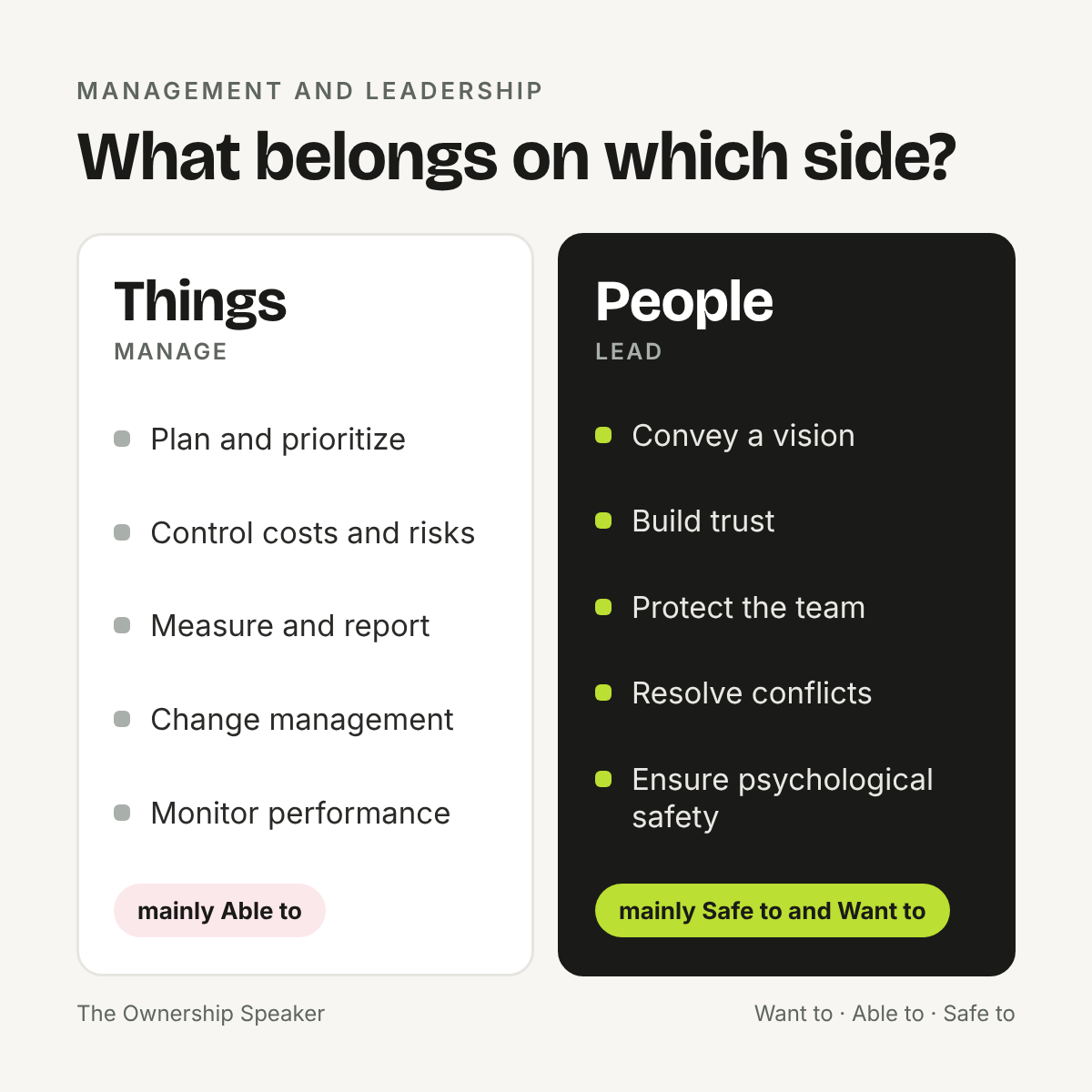
The computer scientist and US Navy rear admiral Grace Hopper is quoted with a sentence that boils the question of the difference between management and leadership down to a few words. If you sort the tasks of managers along this sentence into two columns, one with tasks directed at people, the other with tasks directed at things, the assignment is more revealing than it appears at first glance.
You manage things, you lead people.
Grace Hopper (attributed)
What belongs on the side of things
The tasks that belong to things include planning and prioritizing work, controlling costs, identifying and managing risks, complying with policies and regulations, measuring and reporting, running meetings, selecting new employees, providing suitable tools, taking care of health and safety, and monitoring performance and delivery. These are tasks that have to be done in every organization, and nobody would think of calling them unimportant, because without them there would be neither reliability nor predictability.
One detail is remarkable for anyone who deals with change professionally. In this sorting, change management belongs on the side of things, that is, with planning, milestones, stakeholder lists and communication plans, while leading a transformation stands on the side of people. This separation is less nitpicking than it sounds, because it explains why an excellently managed change initiative can still fail if nobody has led the people in it.
What belongs on the side of people
On the side of leadership stand conveying a vision, building and maintaining trust, celebrating successes, supporting people in difficult times, representing and protecting the team, resolving conflicts, coaching and mentoring, setting goals together and promoting careers rather than mere positions. A point of its own is that leadership ensures psychological safety, and this explicitly means a task of managers and not a trait that a team happens to bring along.
If you compare this list with the Ownership Triangle, you quickly see the distribution. Able to depends to a large extent on things, namely on tools, processes and clear priorities, while Safe to and Want to depend almost entirely on people, that is, on trust, protection, meaning and the permission to make one's own decisions. Ownership needs both, but the weighting decides whether it arises.
When people are managed like things
The most common pattern is the confusion of the two columns. Leaders under pressure prefer to reach for the instruments of the things side because they are tangible, and apply them to people, with metrics for individuals, tight reporting and control loops that are meant to create certainty. For the leader, an impression of control really does arise, but for the employees it means that trust has been replaced by surveillance, and those who are monitored rarely take on more responsibility than they have to.
This pattern intensifies when teams work in a distributed way. For distributed teams, one of the first rules of psychological safety is therefore to look at results instead of output, and this distinction is central to ownership. Output is what is visible, that is, hours, messages, presence in video calls and completed tasks. A result, by contrast, is the impact that arises, and responsibility can sensibly be taken only for impact, not for activity.
Clarity is the prerequisite for freedom
Among the basic rules of psychological safety is a point that seems inconspicuous at first, namely making sure that everyone knows what is expected of them. That sounds like a matter of course, and yet in practice it is one of the most frequent causes of uncertainty in teams, which then shows up as reticence. People who do not know by what their contribution is measured avoid decisions because they cannot assess the risk, and when in doubt they would rather get approval than act themselves.
Clear expectations are therefore not the opposite of freedom, but its prerequisite. When it is settled which result is to be achieved, which limits apply and by what success will be recognized, people can choose the path themselves, and it is precisely this choice that turns an assigned task into one that someone is accountable for. Added to this are values and rules of conduct that are defined together, regular reviews, and the advice to remain consistent in the face of negative behavior, so that safety is not confused with arbitrariness.
Look for your own mistakes first
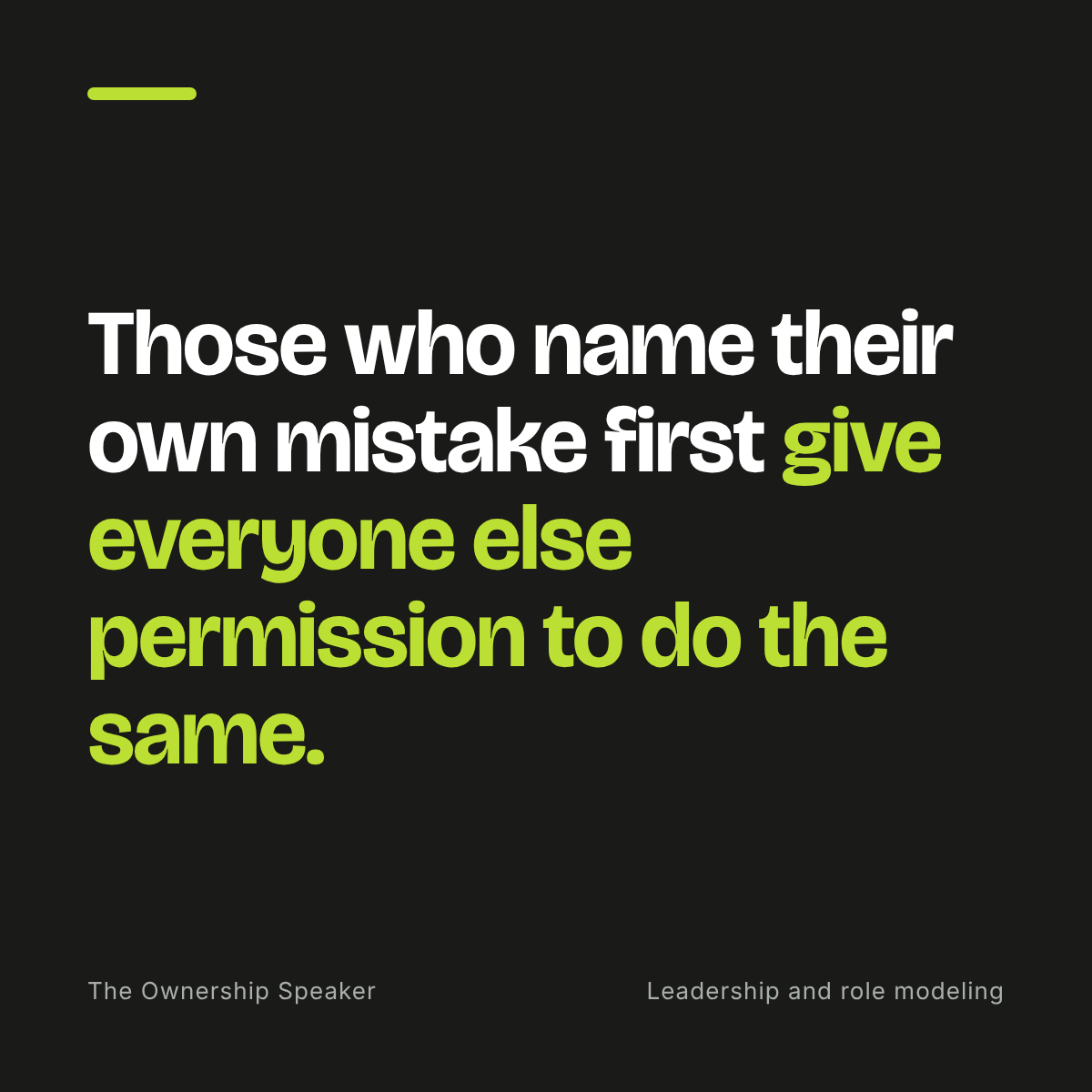
Two further rules deserve attention because they concern the behavior of leadership. The recommendation to admit mistakes yourself first and to actively seek feedback sounds like an appeal to modesty, but it is above all a mechanism that models ownership and gives others permission to do the same. The recommendation to apply Hanlon's razor, that is, not to hastily attribute mistakes and delays to bad intent when overload, misunderstandings or missing information are enough of an explanation, protects against a reflex that occurs frequently in change initiatives and destroys trust in a short time.
The inconspicuously worded advice to put on your own oxygen mask first also carries weight in this context. Leadership that is permanently overloaded falls back on control under pressure and not on trust, so that taking care of your own resilience is ultimately also a condition for the team getting room to maneuver.
What this means for communicating change
For change communication, the distinction has a practical consequence that is often underestimated. A communication plan with channels, dates and messages belongs on the side of things, and it is indispensable, but it only ensures that information is rolled out, not that people make it their own. Whether that happens is decided on the side of people, that is, by whether managers can credibly explain why a change is necessary, whether follow-up questions are welcome and whether it becomes visible what changes on the basis of the feedback.
Those who understand communication mainly as the distribution of content measure reach and open rates and are then surprised that approval fails to materialize. Those who understand it as a leadership task ask instead which conversations the leaders can have in their teams, how much room for decisions they have in doing so and what they do when disagreement comes. This shifts the focus of the work from producing material to enabling the people who translate this material into conversations, and it turns those responsible for change into partners of leadership rather than its text department.
Questions for leaders
The distinction works as a mirror for your own daily work, and those who use it as an occasion for an honest stocktaking can begin with a few questions.
Those who answer these questions usually gain less insight about the team than about their own role. Ownership does not arise from people being assigned more responsibility, but from leadership creating the conditions under which responsibility can be taken, namely clarity about the result, trust in the person and protection in case something goes wrong. Managing things remains indispensable, but leading people decides whether they make the results their own.
Sources
psychsafety.co.uk: Poster “Management and Leadership” with the quote “You manage things, you lead people” (attributed to Grace Hopper), illustration deisatremarias. psychsafety.co.uk, behance.net/deisatremarias