
Model
The Ownership Triangle
The Ownership Triangle is a model by Stephanie Selmer. It says that ownership in an organization does not depend on personality, but on whether three conditions come together: people are able to carry responsibility, they dare to do so, and they want to.
In practice, the same pattern shows up again and again: employees show initiative when exactly three key conditions are met at the same time.
What is the Ownership Triangle?
The Ownership Triangle is a model by Stephanie Selmer that explains why people in some organizations take responsibility as a matter of course and in others do not.
Taking responsibility is not simply a personality trait. It is the result of whether three conditions come together in an organization:
- Able to
- Safe to
- Want to
The model is simple because it knows only three conditions, and still complete because every obstacle to initiative can be assigned to one of these three conditions.
Looking at it in detail lets organizations quickly and precisely see where things really get stuck.
What do Able to, Safe to and Want to mean?
Able to. Safe to. Want to.
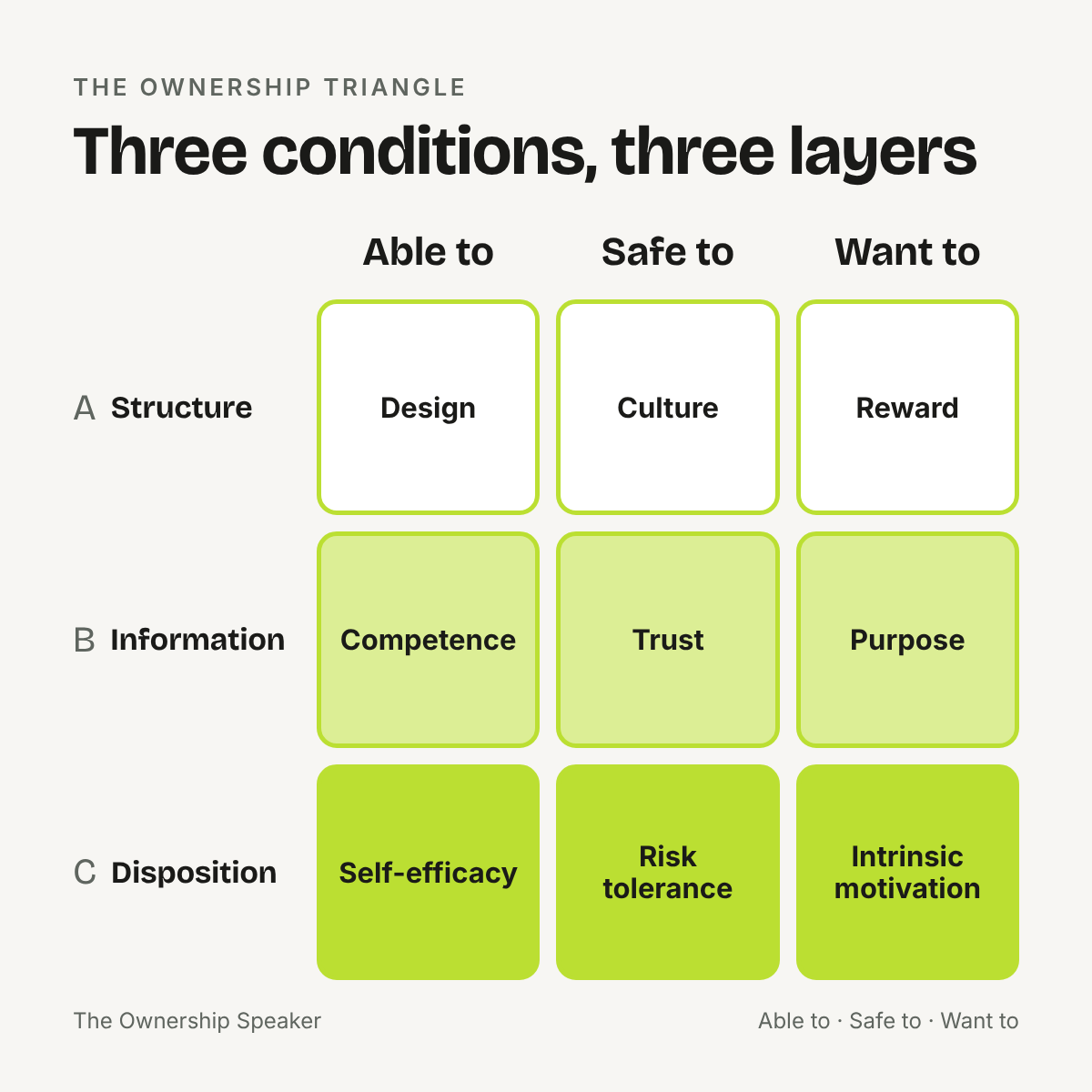
Three conditions have to come together. Each of them stands on three blocks, built from structure, information and disposition.
Able to
The real ability to fulfill responsibility, through one's own competence and resources, decision-making authority.
- Design
- Competence
- Self-efficacy
Safe to
The space created from outside in which people dare to actually take on responsibility, without fear of mistakes or loss of power.
- Culture
- Trust
- Risk tolerance
Want to
The inner drive to take on responsibility out of genuine interest in the outcome, not out of a sense of duty.
- Reward
- Purpose
- Intrinsic motivation
Structure
The structure the organization operates in.
Information
The information people have access to.
Disposition
The disposition each individual brings with them.
Where does the model come from?
The Ownership Triangle grew out of almost 20 years of experience in change projects. Again and again, business owners and leaders relied mainly on intrinsic motivation and overlooked that ownership depends on a fragile balance of several building blocks. People often could not name this gap, they only felt an unease, a sense that something was not right, on both sides: leaders did not know why they had to demand ownership again and again, and employees could not say why they did not take it on. This created the aim to make this feeling visible and tangible, simple enough to work with, without oversimplifying it or putting anyone on the spot.
How does it relate to other models?
The Ownership Triangle is a framework that connects three conditions into one complete picture. It builds on established research and has been tested in change projects over many years, because the same pattern shows up there regardless of industry or company size.
Each of the three conditions has its own well-documented tradition. Amy Edmondson's research on psychological safety describes when people feel safe to take responsibility. Simon Sinek's Golden Circle puts the why at the center and so explains the drive, which is the Want to. Albert Bandura's research on self-efficacy shows how strongly belief in one's own ability works, which is the Able to. Each of these models illuminates one condition precisely and thoroughly.
The Ownership Triangle brings these perspectives together and shows that ownership only emerges when all three conditions are met at the same time. An organization that builds psychological safety also needs Able to and Want to, and a clear purpose only carries when people feel safe and are able to act on it. This makes visible where things actually get stuck and what is needed next.
Why do appeals not create ownership?
The most common lever that leaders and companies reach for is the appeal: people should take more responsibility, show more initiative and think along more. In doing so they address intrinsic motivation, and with it exactly one of the nine building blocks of the Ownership Triangle, namely Want to at the level of disposition.
One block out of nine is not enough to expect ownership. The other eight sit in the structure the organization operates in, in the information people have access to, and in the prerequisites for Able to and Safe to. Where one of them is missing, an appeal mainly creates more work and more frustration, because people sense the expectation and cannot meet it under these conditions.
Appeals are so widespread often because the view of the remaining blocks is missing. Anyone who sees only one section starts where they can look. The Ownership Triangle makes all nine blocks visible and opens the view of the bigger picture, so that organizations can start where something is actually missing.
How can ownership be assessed?
The Ownership Triangle works as a diagnostic tool. Instead of asking how people can be motivated better, it asks at which of the nine points something is actually missing in an organization: in how tasks are designed, in trust, in information, in purpose or in what each individual brings with them. Only once that point is found can you start in a targeted way, without spending energy where nothing is stuck.
The Ownership Assessment makes this view of the bigger picture practical. You see where Able to, Safe to and Want to come together in your organization and where they do not, answer a few questions and receive a tailored offer by email.
How to cite
Selmer, Stephanie: The Ownership Triangle. The Ownership Speaker. https://theownershipspeaker.com/ownership-triangle.html
About the author
Stephanie Selmer is a keynote speaker, consultant and author with more than 15 years of experience in change management and change communication. She developed the Ownership Triangle. More about Stephanie Selmer
Read more
Where does your organization stand on ownership?
The Assessment shows in a few minutes where ownership breaks apart in your organization.
Start the Assessment