October 27, 2026 · by Stephanie Selmer · 8 min read
In a large area a silent fifteen-minute slot for reflection is cancelled because it produces no output, and the employee responsible acts in line with the rules. The case shows that ownership means standing up for the purpose and not for the wording, and that rules turn into checklists as soon as deviating costs more than checking off.
In a project I am accompanying, a fifteen-minute slot in which people reflect silently on a single question was cancelled, with the justification that it produces no output. The employee who decided this applied the area’s meeting rules correctly and still achieved the opposite of what they are meant for, because she defended the wording of the rule and not its purpose.
The format had come about at the request of the leadership, who wanted more room for reflection for their team. On changing days an appointment appears in the calendar, the participants come, are given a question and think about it silently for fifteen minutes. Later meeting rules were introduced for the whole area, which nobody found unusual, namely that only those who are really needed are invited, that only those who can contribute stay, and that from now on there should only be meaningful meetings.
When these rules were implemented, the silent slot dropped out because, in the employee’s assessment, it was not a necessary meeting, since there was no output. You can be annoyed by this justification, and I was, but the case becomes more interesting once the annoyance is set aside, because it shows a mechanism that works in many organizations and has little to do with this one person.
The rule demanded judgment and got a checkmark.
What does a rule like “only meaningful meetings” demand?
The sentence that there should only be meaningful meetings contains a judgment, because whether a meeting is meaningful cannot be read off a list but can only be answered by knowing what it is meant for. Whoever wants to apply it must therefore ask what purpose an appointment is supposed to serve, whether it serves it and whether there is a better way to get there.
The employee replaced this question with a simpler one, namely whether something exists at the end that can be shown. This is convenient, because the criterion can be checked in seconds, and it works quite well for most meetings, since meetings after which nothing exists are in fact often dispensable. For fifteen minutes of silence, whose result emerges in the participants’ heads and stays there, it is however the wrong measure.
The result of this appointment is not empty, it is just not visible. People who have spent fifteen minutes with a question go into the next meeting differently than before, and nobody measures that anywhere. The rule wanted less wasted time, and an appointment that makes thinking possible is the opposite of that.
On top of that, the format that gives people room for conscious thinking was cancelled without conscious thinking.
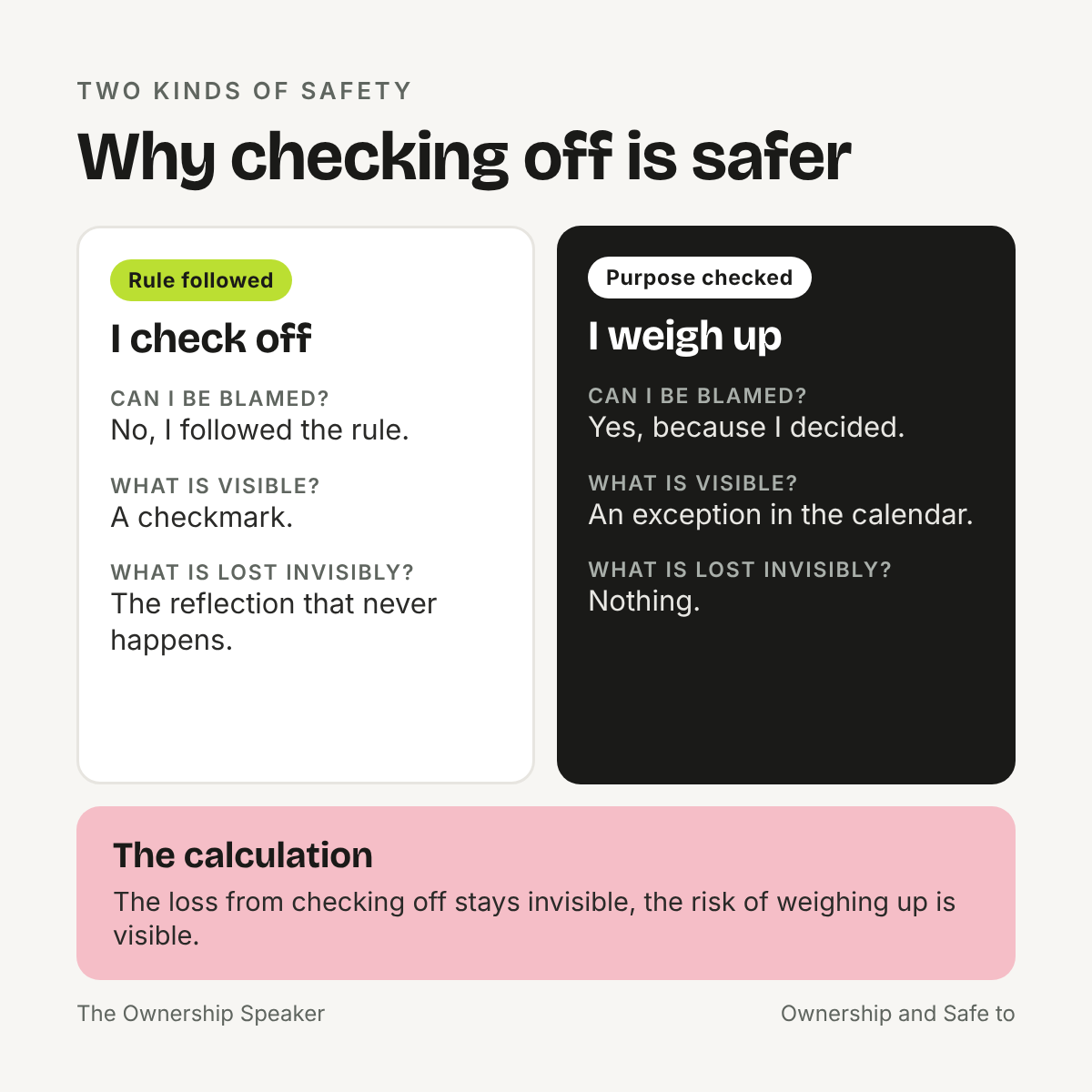
Why is checking off so much safer than weighing?
Whoever applies the rule can invoke it. Nobody will tell the employee she behaved wrongly, because she did what could be expected of her. Whoever had instead declared this format an exception would have made a decision, and one can be held accountable for decisions. Moreover the costs are unevenly distributed, because an appointment wrongly cancelled is noticed by nobody, since the missing reflection appears nowhere, while an appointment wrongly kept stands in the calendar and is visible. Behind this lies no ill will but a calculation that almost anyone in her position would make in the same way, and the loss is borne in the end by many hundreds of people who were not asked.
What does this have to do with Safe to?
In the ownership model Safe to means that someone dares to do something because they can reckon with the consequences and do not pay a disproportionate price for it. What the organization has created in this case is a different kind of safety, namely the safety of not being held accountable. Both are called safe, and the two are opponents, because where you can protect yourself by not deciding, exactly that is chosen.
This is not a question of character. Every organization that introduces rules and does not expressly provide for deviations rewards those who take them literally and quietly punishes those who interpret them. The employee behaved rationally in this situation, and that makes the case uncomfortable, because you cannot blame her for anything you would not also have to blame on the rule, which rewards checking off and does not provide for weighing.
What does it mean to stand up for the purpose?
Ownership means standing up for the result and not for the wording of a task. Whoever truly experiences a task as their own asks of every rule what it is there for and acts accordingly. Mostly this means applying it, sometimes interpreting it, and rarely deliberately not applying it and standing up for that. In this case the question of what the format is for and who wanted it would have been enough, because nobody would have had to break a rule for that. The employee took full responsibility for the result “rules are followed.” For the result “people reflect” she never had any, because it was never handed to her. Purpose and wording usually coincide, which is why the difference is so rarely noticed, and only in edge cases like this one do they part.
Did the employee have to break the rule?
No, and that is the core of the case. The rule demands meaningful meetings and thus a judgment, and whoever makes this judgment applies the rule instead of breaking it. A rule break would only be necessary if wording and purpose were incompatible, and even then ownership would not consist of the break but of the willingness to justify it and stand behind it. This case was far from that. It would have been enough to take the rule seriously, in the way it was meant.
The expectation that people in organizations deliberately break rules misses the problem anyway, because whoever is supposed to stand up for the purpose first needs the certainty that they will not be punished for it. Where this certainty is missing, hardly anyone will interpret, and where it is present, hardly anyone has to break.
What would have to happen for the format to return?
From her own logic nothing will change, and not out of unwillingness but because checking off still pays off more for her than deviating. As long as that is so, she will see no reason to change her judgment, and therefore an impulse from outside is needed.
The kind of impulse matters here. If the only thing that comes from above is the instruction that the format stays, she again gets a safeguard, only a different one, and she keeps the format up because it was ordered, not because she understands its purpose. The wording has then changed, the attitude has remained the same. Ownership for the result arises only when two things come together, namely that someone explains the purpose and that someone expressly backs the exception, so that she dares to stand up for it.
Both must come from a person she believes and who carries weight in her world. Here lies the real difficulty of the case, because the person who originally wanted the format knows nothing about the cancellation and does not want to deal with it at this level. This is understandable, because nobody can follow every appointment in the calendar of their area, and it still has a consequence: A concern that nobody represents at the level of implementation is at the mercy of the first rule that comes along there. Whether the format returns is open at the time of this text.
How do organizations write rules that preserve judgment?
Rules that demand judgment become checklists as soon as deviating costs more than checking off. Whoever wants to change this must lower the price of deviating instead of hoping for courage. This includes supplying the purpose with every rule, providing a path for justified exceptions and naming a person who may decide on them. An exception should not count as a rule break but as an intended part of the rule, otherwise it remains a risk for whoever uses it. And it helps not only to count what emerges in meetings but also to ask what would not emerge without them.
Whoever wants to check this for their own rules can start with a few questions.
Whoever introduces rules should ask themselves in the end whether they lead people to protect the purpose or only to protect themselves.
Sources
Experience from consulting practice, anonymized and altered.
Ownership
Safe to
Meeting rules
Organizational development
Where does your organization stand on ownership?
The Assessment compares your organization with others and delivers concrete recommendations, not just a diagnosis.