October 28, 2026 · by Stephanie Selmer · 7 min read
Those who are accountable for results but may not decide about the causes do not take ownership, they endure. The article shows why the missing Safe to then sits in the structure and what leaders can still do in this situation.
There is a situation that many leaders know and rarely talk about openly, because it sounds like complaining although it describes a structural problem. In the Harvard Business Review newsletter I read a starting point that I find fitting for this: A manager takes over a team in which one person permanently falls short of expectations, and she can neither replace this person nor fully hold them to account, because another manager is holding a protective hand over them.
She still carries the team’s results, because that is what she is measured on, but the authority to fix the cause lies elsewhere. If she takes over the person’s work herself, she uses up her own capacity and at the same time takes away the team’s signal that performance counts, and if she does nothing, she carries a result that she is not allowed to influence.
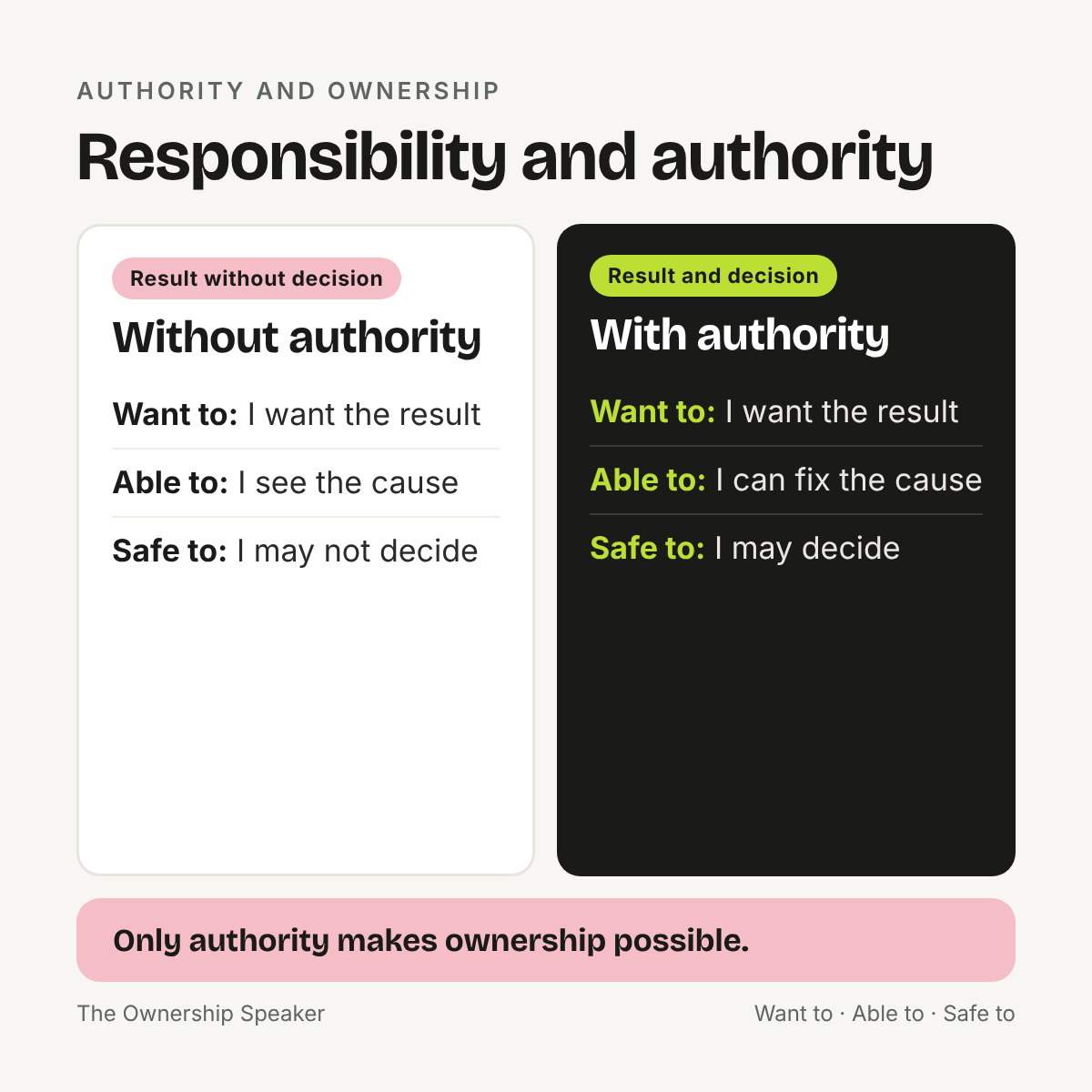
Seen through the ownership lens, this is a Safe to problem that sits on an unfamiliar side. The manager wants the result, she has the Able to to produce it, and still she cannot act, because nobody grants her what would be needed for it. The Safe to is not missing in the person who performs poorly, it is missing in the structure that assigns responsibility and withholds authority.
Responsibility without authority is not ownership but enduring.
Why does the missing Safe to not sit with the person?
When we talk about ownership, we mostly think of people who have to trust themselves with something, and in doing so we overlook that Safe to is also a property of organizations. Whether someone may solve a problem is not decided in the person’s head but by who gives them access to staff, budget or priorities, and in companies these accesses are often distributed differently than the job description suggests.
A manager who is responsible for a team and may not decide anything about the central personnel question has the Want to and the Able to and fails at a barrier that she did not build. Whoever advises her in this situation to show more initiative confuses a structural problem with a mentality problem and loads the burden additionally onto the person who can change the least.
On top of that, the situation is barely visible from the outside. From the team’s point of view it looks as if the manager tolerates the weak performance, and from above it looks as if she lacks assertiveness, although neither has anything to do with her behavior but with the authority that nobody has given her.
What are the first two steps?
The first step is to name the restriction, that is, to check whether the person is really protected or merely difficult, to raise their performance pattern with the responsible leadership and to observe what happens as a result. The second step tests the support by asking the protecting manager to publicly back one single concrete performance expectation. The reaction shows whether real accountability is possible in this system at all, and you learn something important without having started a conflict, because a single sentence is not a declaration of war but a test.
How do you distribute work without covering up the situation?
The third step is to redistribute critical work and to give more people in the team the authority to move the project forward, so that the dependency on the one person decreases. This has a side effect that is valuable for ownership, because the other colleagues experience that more is entrusted to them, and joint coordination in the team creates visibility about who carries what.
In the fourth step you consciously decide what you carry yourself. Step in where inaction would mean a serious risk, but tell your own superior openly what you are covering, why, for how long and what is left undone as a result. Only this statement turns quiet compensation into a decision that somebody can see and support, and secret extra work into information that the organization is entitled to.
The danger lies in stepping in becoming the permanent solution. What begins as an emergency measure becomes an expectation after a few months, and then the gap is no longer perceived as a gap but as a normal state that you have produced yourself.
Why does a fair process count for more than a fair state?
The fifth step is to hold the line, and it contains the smartest distinction of the whole situation. That someone is protected and others can see it is an unfair state that you probably cannot change, but how you deal with it in your team is a process that you shape. Make the expectations clear for everyone, acknowledge the frustration without defending the unequal treatment, and emphasize the standards consistently. This does not take the anger away from the team, but it gives them the certainty that somebody is looking, and exactly this supports Safe to in the rest of the team.
How does this differ from acting on your own without a mandate?
An earlier article on this blog was about a discretion that nobody had granted and that a person therefore filled according to their own morals. Here the counterpart applies, because the mandate has been given and the authority is missing. Both cases have the same root, namely that responsibility and the right to decide were not thought together, and neither is resolved through more discipline of those involved but through a clarification at the level above.
That is uncomfortable because this clarification can rarely be forced from below. What you can do is describe the gap in such a way that it no longer stays private, because as long as you compensate for it silently, the organization sees no reason to change anything about how authority is distributed.
What does it cost when nobody sees the gap?
The costs of this constellation appear in no key figure, because they show up in things that do not happen. The manager who silently compensates is more exhausted than necessary and has less attention for what she was actually appointed to do, the team learns that performance does not count when somebody has the right connections, and the protected person never gets the feedback they would need to develop.
In the long run a pattern emerges in which the most capable people leave or quit inwardly, because they grasp the bill earlier than the organization does. That is the price for responsibility and authority being separated, and it is not paid by the person who caused the separation.
How do you recognize that you lack authority?
A few questions help to distinguish your own situation from mere dissatisfaction.
Responsibility and authority belong together, and where they fall apart, it is not a question of attitude but of design.
Sources
Reflections after reading the newsletter “The Management Tip of the Day” (Harvard Business Review, issue of September 29, 2026). hbr.org
Ownership
Safe to
Authority
Leadership
Where does your organization stand on ownership?
The Assessment compares your organization with others and delivers concrete recommendations, not just a diagnosis.