Hardly anyone knows the man who probably saved millions of lives
November 2, 2026 · by Stephanie Selmer · 10 min read
A computer reported the launch of five missiles, and a man on shift decided not to pass the message on as an attack. The story of Stanislav Petrov shows what it takes to contradict the system you operate, and what an organization owes the person who does.
Shortly after midnight on September 26, 1983, the sirens howled in a bunker south of Moscow, and the display lit up with the word launch. The Soviet early-warning system Oko, which used satellites to watch the missile fields of the United States, reported an intercontinental missile from Montana, and shortly afterwards four more were added. The officer on duty was Lieutenant Colonel Stanislav Petrov, an engineer who was running the shift that night, and his task was to pass such a message on to the leadership, which would then have decided on a counterstrike.
The situation was tense, because only three weeks earlier Soviet air defense had shot down a South Korean passenger plane, 269 people had died, and the leadership in Moscow feared an American first strike. Petrov could therefore have passed the message on without anyone blaming him, because the system had explicitly been built to rule out false alarms, and it reported with the highest certainty.
And then he had to decide, within a few minutes, because the missiles, had they existed, would have been in flight for about half an hour, and the path from his report via the general staff to a counterstrike was designed to be fast. Nobody took the decision off his hands, there was no time for an expert opinion and no feedback he could have waited for, because the only thing that could have confirmed the message beyond doubt would have been the impact. All he had was the display, his knowledge of the system and what he knew about the world.
He later described that he was paralyzed, that he should have reached for the phone to the top commanders and could not move, and that he felt as if he were sitting on a hot stove. In the end he did not call the leadership but reported a malfunction of the system to headquarters, and from then on all that remained was waiting. It is hard to imagine how long those minutes must have been, because the confirmation that he was right could consist only in nothing happening, and nothing happens very slowly in a room where the system keeps reporting more missiles. Only after a good twenty minutes, when the first impacts should long since have occurred, was it clear to him that he had been right.
At this point a role turns into a decision that somebody has to carry. In this situation ownership does not mean carefully completing a task but deciding something that no rule, no superior and no confirmation secures, and treating the outcome as your own affair, no matter how it ends.
He was right, and it took months until investigators found the reason, namely sunlight reflecting off high clouds that the satellites interpreted as a missile launch.
A system message is only a finding. Real ownership must be able to refute it.
How many lives were at stake?
There is no exact figure, but the order of magnitude can be named. An estimate by the Office of Technology Assessment of the US Congress from 1979 expected that a large-scale Soviet attack would kill 35 to 77 percent of the American population, which by the population of 1983 means between 82 and 180 million people, and that the American counterstrike would kill 20 to 40 percent of the Soviet population, that is 54 to 108 million. Together that makes 136 to 288 million deaths, and hunger, radiation and climate effects are not yet included.
More recent simulations arrive at similar orders of magnitude. A simulation by Princeton University from 2019, based on today’s arsenals, calculates in one scenario more than 90 million dead and injured within the first hours of a war between the United States and Russia, and a study led by Rutgers University from 2022 estimates that after a full exchange more than five billion people would die from the consequences of hunger, because the soot from firestorms blocks sunlight and harvests collapse.
Whether Petrov’s message would actually have led to a counterstrike nobody knows, because between it and a launch order stood the general staff and the state leadership, and the figures are estimates and not forecasts. Yet even those who calculate very cautiously and take only a fraction of it end up with millions of lives, and that is why I consider the sentence defensible that this man probably saved millions of people’s lives.
What did he doubt?
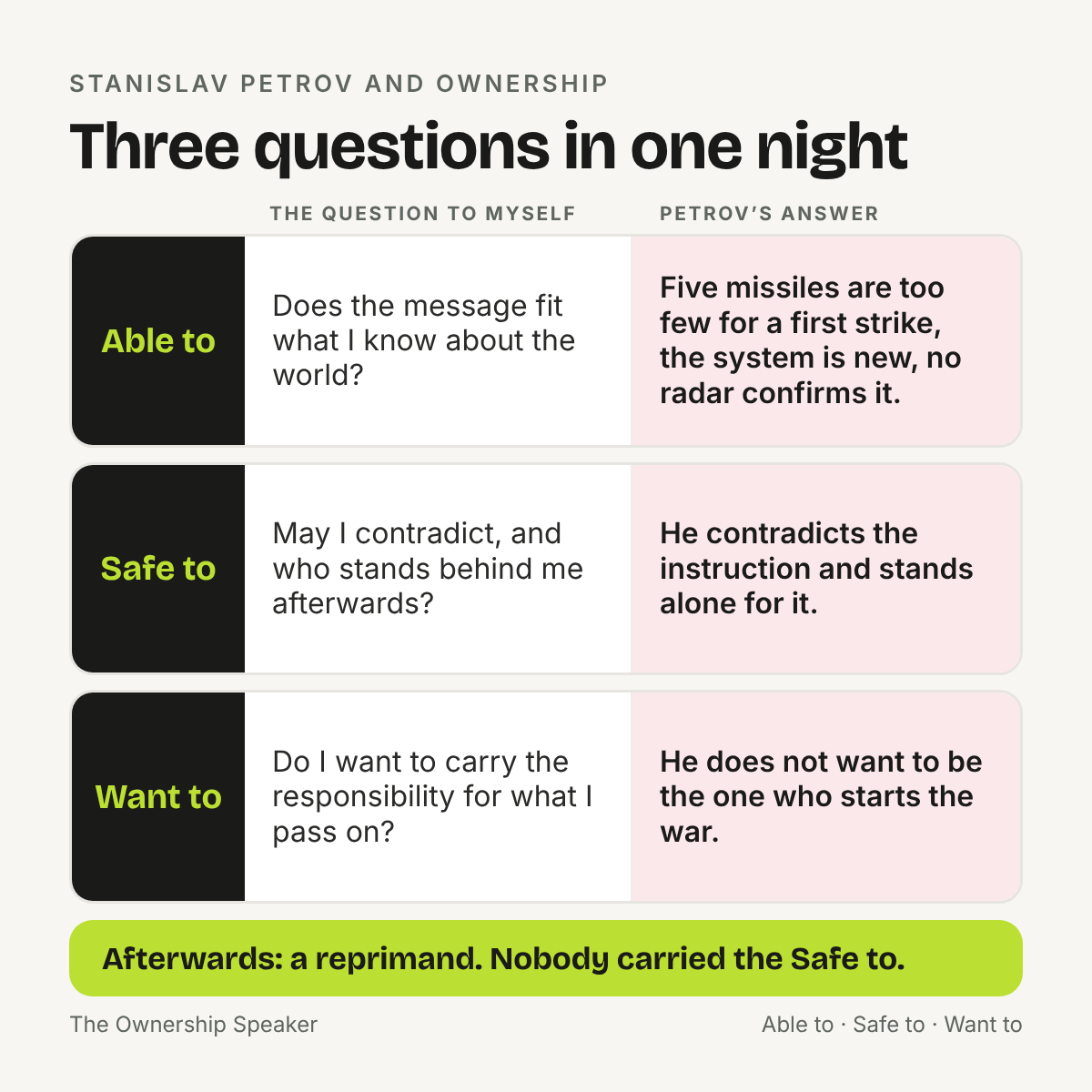
Petrov later told several times what made him doubt, and the reasons are revealing because almost all of them come from Able to. Five missiles seemed too few to him for an attack meant to knock out the Soviet Union, because whoever plans a first strike does not send five but very many. The system was new and he did not fully trust it, and the ground-based radars, which should have detected a real missile after a few minutes, confirmed nothing. His own assessment was about fifty-fifty, so it was not certainty but a weighing under time pressure.
It is remarkable that he had no proof but carried out a plausibility check that is familiar in any profession, namely whether what the machine claims fits what you know about the world. That is Able to in the sense of ownership, and it does not consist of carrying out the task by the book but of knowing the limits of the system you operate. Whoever only masters the operation passes on what is displayed, and whoever knows the limits can say no.
Passing it on was the comfortable path, though, not out of cowardice but out of the logic of roles. Whoever passes on by the book has done their duty even if the message later turns out to be false, because then the error lies with the system. Whoever does not pass on pulls the decision onto themselves and from that moment has nobody left to point to. This asymmetry applies in every organization in which rules offer protection, and it explains why so many clever people, at the decisive moment, simply pass things on.
What belonged to Safe to?
Able to was joined by Safe to, and it was not a matter of daredevilry. Petrov knew that his instruction was to pass the message on and that with his decision he acted against this requirement, and he also knew that in case of doubt he would have to answer for it alone. Had he been wrong, the damage would have been immeasurable, and he could not have justified it with any rule. Later he said he had not wanted to be the one who starts a world war, and in that lies the Want to, which here did not come from enthusiasm but from the weight of what was at stake.
What did the organization make of it?
One would expect an organization to honor an employee who decided like this, and at first it looked that way. By his own account Petrov was praised at the beginning and promised a reward, but it never came. Instead he was reprimanded for his record-keeping and reassigned, and he explained it by saying that the false alarm and the flaws in the early-warning system discovered afterwards would have embarrassed high-ranking officers and scientists.
That is the most uncomfortable part of the story, because it shows how an organization can react when somebody is right without it suiting them. It did not punish the decision but found an occasion in the administration, and the message that reached other officers is likely to have been clear, that doing the right thing is a personal risk that nobody insures.
Ownership needs both, the person who is ready and the organization that does not work against them afterwards. Where the courage is carried alone, it remains an exception and does not become a feature of the organization, and next time perhaps somebody sits at the console who cannot afford it.
What does this mean for systems with AI?
The parallel to today’s systems is obvious, because an AI too delivers results with great certainty and often without any indication of where it could fail. Whoever operates such a system faces the same question as Petrov, namely whether to pass on what is displayed or to check whether it fits the situation. For that they need three things, knowledge of the system’s limits, permission to contradict and the certainty that no disadvantage will follow. The first can be trained, the second and the third can only be given by leadership, and it has to say so before the alarm goes off, because then there is no time left to negotiate.
Is this a hero story?
I would not turn the story into a hero fairy tale, because it contains a second lesson. A system whose safety hangs on the judgment of a single person on a single night is badly built, and that it ended well was also luck. The human in the system was intended as a relay here, and that he was more was down to him and not to the design.
For organizations, ownership therefore means designing the role of the human in the system deliberately. Where a human has the last word, they need the knowledge, the time and the backing for it, before they need it, and not only once they have decided alone at night.
What can be clarified beforehand?
If you read the night as a design question, a series of things emerges that an organization can settle before the emergency. It can define who may stop a message, by which criteria that is allowed and who immediately obtains a second opinion in that case, so that the decision does not hang on one person alone. It can also clarify what happens afterwards if the doubt was justified, and that includes that a justified objection is recognized and not answered with formalities. And it can evaluate every false alarm, as a pointer to the limits of the system and not as an embarrassment that is better forgotten. All of this costs little in everyday work, and it decides whether a lucky night becomes a reliable practice.
Where may someone in your area contradict the system?
Anyone who wants to check this for their own area can start with a few questions.
Whoever wants people to contradict in an emergency has to have shown them beforehand that it is worth it.
Sources
Reflections after reading accounts of the Stanislav Petrov case: Radio Free Europe/Radio Liberty. rferl.org
Obituary of Stanislav Petrov in TIME magazine (2017). time.com
“September 1983: Soviet officer defies military protocol, averting potential nuclear war” (APS News, September 11, 2026). aps.org
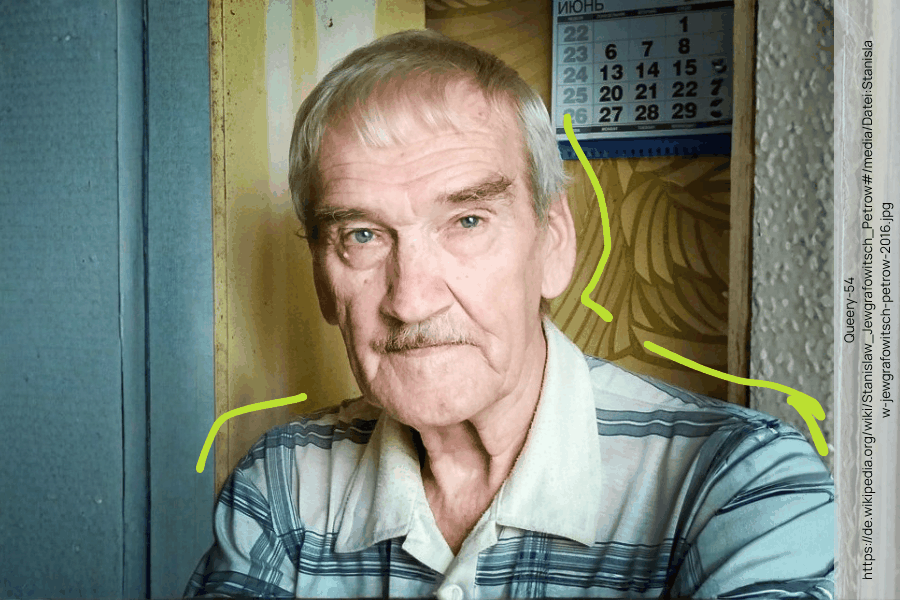
Cover image: Stanislav Petrov, 2016. Photo: Queery-54, via Wikipedia (file “Stanislaw-jewgrafowitsch-petrow-2016.jpg”). de.wikipedia.org
On the casualty figures: estimate by the Office of Technology Assessment of the US Congress from 1979, reproduced in an article about Petrov. incidentdatabase.ai
“Plan A”, simulation of a nuclear war between the United States and Russia (Princeton University, Science and Global Security, 2019). sgs.princeton.edu
Study led by Rutgers University on famine after a nuclear war (Nature Food, August 2022), report about it. earth.com
Ownership
Safe to
Artificial intelligence
Judgment
Where does your organization stand on ownership?
The Assessment compares your organization with others and delivers concrete recommendations, not just a diagnosis.