November 6, 2026 · by Stephanie Selmer · 6 min read
AI rollouts rarely fail because of the technology, they fail because of the story that is told about it and because of skill lists that overwhelm. The article looks at expectation and skills through the lens of Want to and Able to.
When an organization introduces AI, a lot is said about tools, licenses and training and little about the story that is told with it, although that story decides whether people accept the technology. In the Harvard Business Review newsletter I read that the way leaders talk about AI predicts how employees take it up, and this matches what I often observe in change projects.
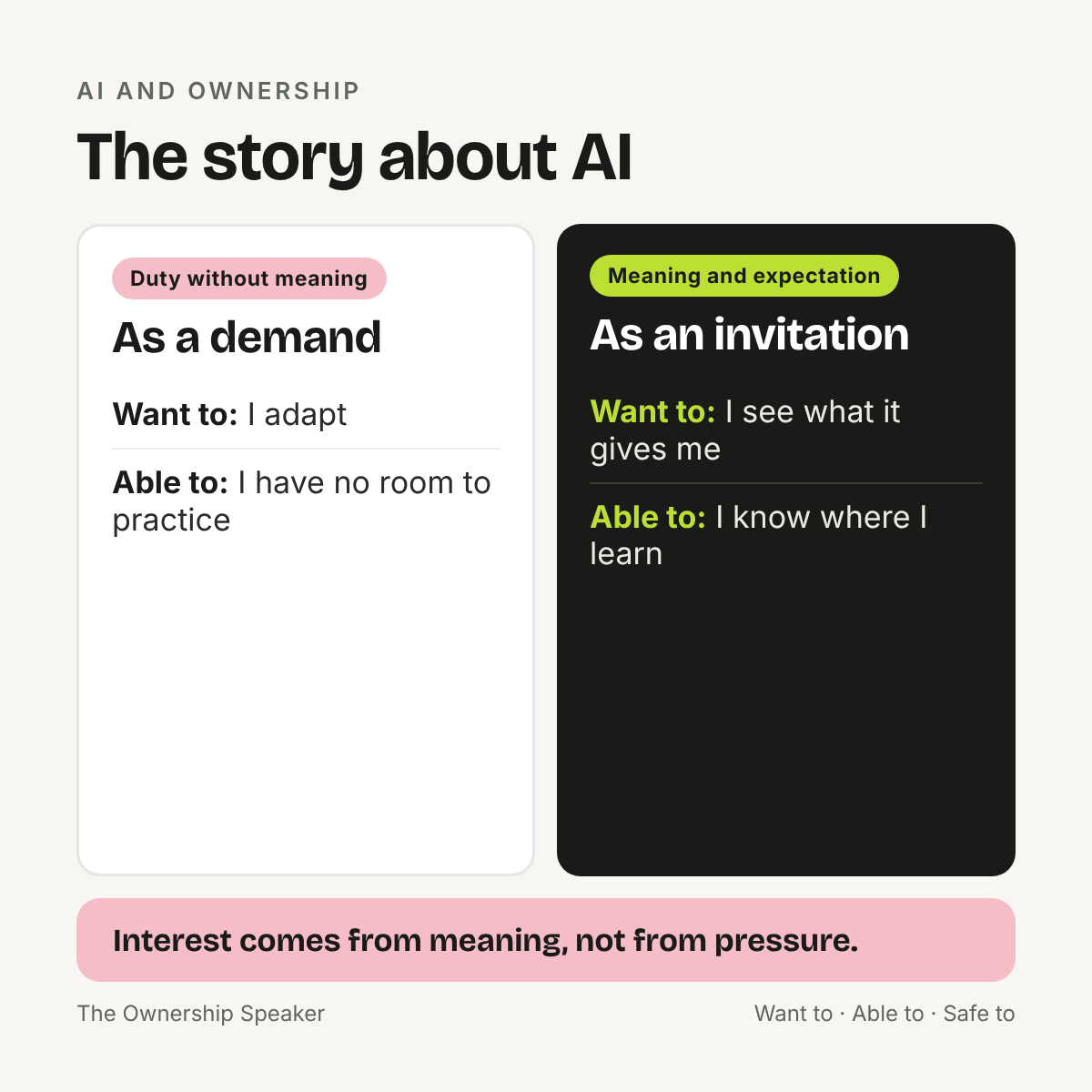
Vague messages leave open what is expected, and stories built from fear or from pure productivity thinking often do not motivate, because they do not address people’s Want to at all. Whoever hears that they are supposed to get faster with AI hears a demand, and whoever hears that jobs will otherwise disappear hears a threat, and both produce compliance instead of interest.
Through the ownership lens, the first prerequisite sits here, Want to. People take up a new way of working when they recognize a meaning in it for themselves, and the leaders’ story is the place where this meaning arises or fails to appear. Able to follows afterwards, because skills are built up above all by those who also want to.
Those who tell the AI story only as a demand get compliance instead of interest.
What belongs in a story that addresses Want to?
Four things can be distinguished. First, the expectation, which is stated clearly and as part of good performance and not as an optional suggestion, because whoever is unsure whether they should use AI will in doubt not use it or will use it secretly. Second, the explanation of why and how AI fits into the work, that is, where it frees up time and by what you can tell.
Third, the framing, which puts growth at the center and not the threat, without glossing over what is uncertain. Fourth, honesty about uncertainty, because leaders may admit that they do not know everything as long as they do not leave the direction open. Whoever says that the way has not been worked out yet but that the goal is fixed gives more support than someone who pretends certainty.
All of this works only if all signals fit together. A message about growth loses its effect if tools are bought at the same time without anybody explaining what for, or if guidelines contain only prohibitions. People read the sum of the signals and not the speech, and the speech alone convinces only if the actions do not refute it.
What happens without a clear expectation?
Imagine a team in which leaders repeatedly call AI a great opportunity but never say whether it is expected in daily work. One colleague experiments at home in the evening, another waits because he does not want to stand out, and a third uses tools secretly because she does not know whether that is welcome. From the leaders’ point of view this looks like low acceptance, from the team’s point of view it is a reasonable reaction to a message that leaves open what applies.
Why do long skill lists overwhelm Able to?
The second prerequisite is Able to, and here the opposite of enabling happens in many companies. AI competence is presented as a growing checklist that gets longer every week, and whoever reads it feels after a short time not more competent but overwhelmed.
In the same newsletter I read a counter-proposal that seems workable to me: a few skills that grow along with the technology. Named are the clear formulation of problems, because the result is only as good as the input, systems thinking, that is, recognizing the consequences of a change in the connected process, and strategic foresight, that is, building what-if scenarios into existing decisions.
The special thing about this selection is that it demands no tool knowledge that is outdated in half a year. Whoever can describe a problem clearly gets further with any tool, and whoever recognizes consequences in the system also notices where a quick AI solution creates work elsewhere. These are skills that are useful even without AI, and that is exactly why it is worth investing in them.
How do you bring Want to and Able to together?
Want to and Able to need each other. A convincing story without an opportunity to learn produces frustration, because people want something that they cannot put into practice, and good training without a story produces indifference, because nobody recognizes what they need it for. If you plan both in one go, that is, explain what the skill is needed for and at the same time make time to practice, you get what succeeds least often in changes, namely that the leaders’ expectation and people’s everyday life fit together.
What does this say about change communication?
I come from change communication, and I notice how similar these patterns are to earlier changes. With new systems, new processes and new structures the same applies: The story decides about Want to, the enabling decides about Able to, and whoever takes care of only one of the two wonders about the effect.
What is new with AI is the speed at which the technology changes and the openness of the question what it does to professions. That makes the honest story harder and at the same time more important, because people notice when certainty is faked and then lose trust in everything that follows.
Where are the limits of this reflection?
These are recommendations from management literature and not reliable evidence for every organization. What works in a corporation with thousands of employees can be oversized in a small team, and the selection of three skills is a premise that one may test and adapt.
The story alone is not enough either. If work intensification is the main effect of AI, a narrative of growth is perceived as a label, and that can weaken Want to rather than strengthen it. The honesty of the story depends on whether practice supports it.
What does this mean for your own AI rollout?
Anyone who wants to check this for their own rollout can start with a few questions.
Safe to, that is, the question whether people speak openly about usage and doubts, is a third task that stands next to these two and needs its own attention.
Sources
Reflections after reading the newsletter “The Management Tip of the Day” (Harvard Business Review, issues of October 7, 2026 and October 13, 2026). hbr.org
Artificial intelligence
Ownership
Want to
Change communication
Where does your organization stand on ownership?
The Assessment compares your organization with others and delivers concrete recommendations, not just a diagnosis.