November 9, 2026 · by Stephanie Selmer · 6 min read
In the ownership triangle, Able to is the real capability to fulfill a responsibility, and it consists of three building blocks, namely design, competence and self-efficacy. Those who only develop competence work on one third of Able to and wonder why good people still do not start acting.
The ownership triangle describes that people in an organization take on responsibility when three conditions come together, namely Able to, Safe to and Want to. Able to is the first and apparently the simplest, because it is the easiest to measure and to promote, and for exactly that reason it is most often understood too narrowly in practice.
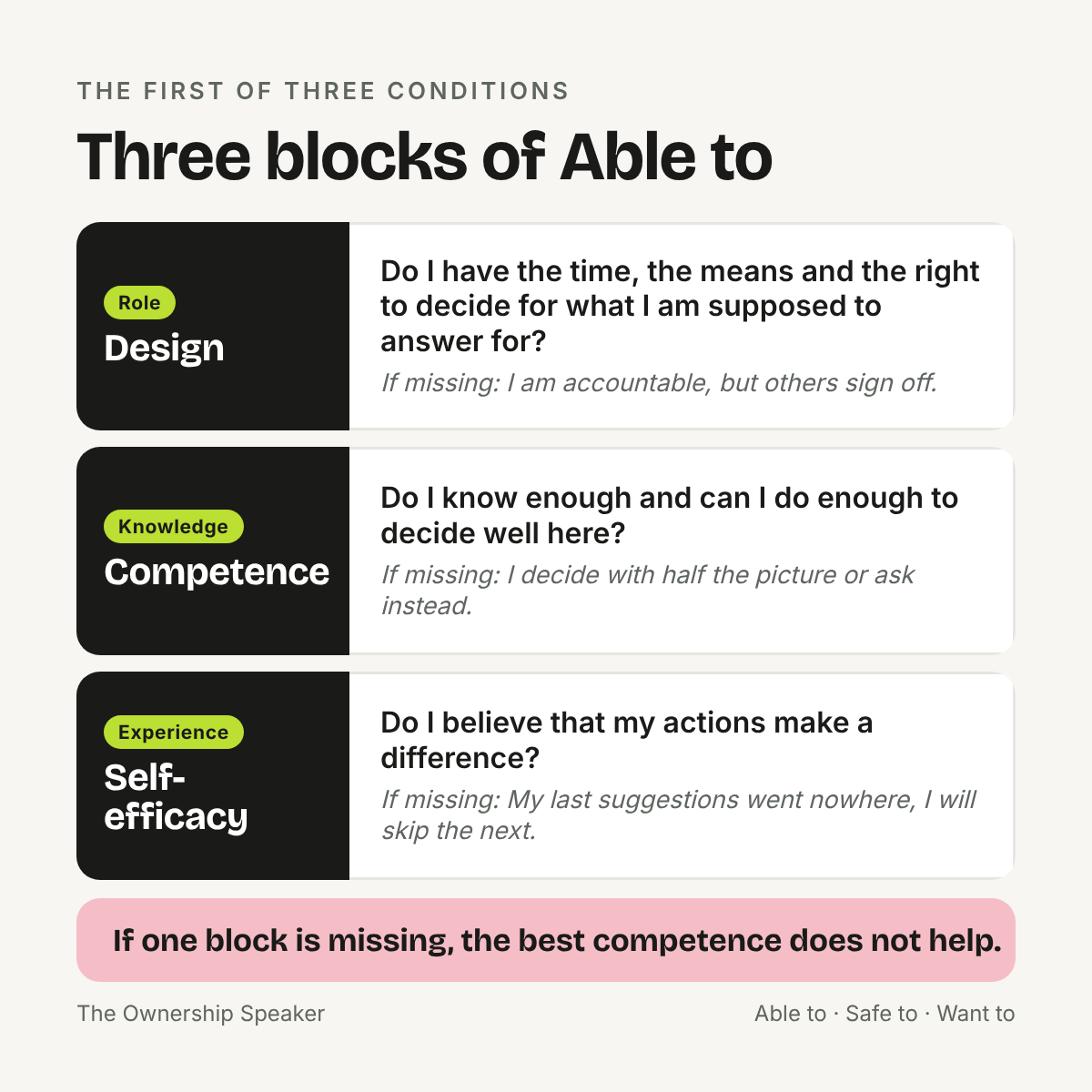
It means the real capability to actually fulfill a responsibility, and real here means that it is not only about the knowledge in your head but about everything that is needed for knowledge to become a decision and for the decision to become a result. For this the model distinguishes three building blocks, namely the design of the role including resources and decision rights, the competence with the necessary skills and information, and the self-efficacy, that is the conviction that your own actions make a difference.
Whoever is meant to carry a responsibility needs all three, and if one of them is missing, the person can be as well trained as they like, they will not act the way an appeal for ownership imagines.
Good people are not enough, they need a role in which they can make a difference.
What is Able to not?
Able to is not the same as competence, even though the two words are often confused in everyday language. Competence says what somebody knows and masters, Able to says whether this person can achieve something with it in their role, and between the two lie the conditions that the organization itself has created.
Able to is also not a certificate, not professional experience and not a personality trait, because the same person who decides as a matter of course in one team can, after only a few weeks in another team, do nothing but ask for permission. That is rarely down to them, but to what the role allows, which information they receive and what they have learned from earlier attempts.
Whoever treats Able to as a property of people looks for the solution in the people and sends them to a training, while the actual problem lies in the design of the role. And whoever equates Able to with experience overlooks that it is precisely experienced people who notice fastest where a role promises more on paper than it delivers in daily life.
Why is Able to not enough on its own?
Those who are able but do not feel safe deliver what is asked and no more, because every decision of their own would be a risk that the culture does not take off their shoulders. Those who are able but do not want to fulfill the task cleanly and without interest in the result, which looks like professionalism from the outside and is still not ownership. Those who are able and willing but do not feel safe keep quiet about what they see, and those who are willing and feel safe but are not able fail at the role and eventually give up. Only in combination with Safe to and Want to does the capability become the attitude that leaders mean when they wish for initiative.
What do companies already do well when it comes to Able to?
In change projects the same pattern has struck me for years, namely that organizations like to invest in competence, because training can be planned, budgeted and ticked off. Many do this well, with careful hiring processes, onboarding, mentoring and learning platforms, and people mostly enter their roles well equipped professionally.
The description of roles has also improved in most houses, with job profiles, responsibility matrices and clear areas of responsibility on paper. That is a solid foundation, and I would never claim that qualification is superfluous, because without it any design would remain ineffective.
Where it gets stuck is rarely the will to develop people, but the assumption that developing skills is enough. Whether the role carries what is expected of it is checked less often than the résumé of the person who is meant to fill it.
What do companies often not do well?
They treat a design problem as a training problem. When people do not decide, the first reaction is to schedule a decision-making workshop, and the question of who in this organization is actually allowed to decide remains unasked. Behind this there is rarely bad intent, more the convenient idea that change has to start with the people because nobody wants to touch the structure. The result is a team that knows more than before and is allowed to move just as little, and next year the same topic is back on the agenda, this time with a different training format. A sign that the design is the issue is therefore the very wish for even more training, when people long since know what would have to be done.
How does a lack of Able to show in daily work?
With design it shows when responsibility is handed over while the decision rights, the budget and the approvals stay one level higher, so that the person is meant to stand for a result they are not allowed to decide on. Many experience this as responsibility without authority, and it leads to behavior that is easily read from outside as passivity.
With competence it is often less the expertise that is missing than the information, such as figures, background on earlier decisions or knowing what the result is needed for, and people then decide with half the picture or prefer to ask, which looks like uncertainty and is in truth caution.
Least often considered is self-efficacy. Whoever has made three suggestions that went nowhere does not make a fourth, and the organization reads that as a lack of initiative, although it is the result of an experience it created itself. Self-efficacy grows when people see that their actions change something, and it fades quietly when nothing comes back.
How do you recognize whether Able to is missing in your organization?
The following questions help to check the three building blocks for your own area. They are phrased from the I perspective because they work best when you answer them together with your team.
Able to is the condition that an organization can shape most clearly itself, and that is why it is worth looking there first when ownership is missing.