November 13, 2026 · by Stephanie Selmer · 6 min read
When new work keeps arriving and nothing ends, time management does not help. The article asks who in your organization decides what takes priority and what overload has to do with ownership.
When a team is overloaded, many organizations first reach for time management, prioritization methods and resilience training, and all three assume that the problem lies with people who do not organize their work well enough. In the Harvard Business Review newsletter I read two tips that classify this differently: Stress arises not only from the amount of work but also from unclear roles and competing expectations.
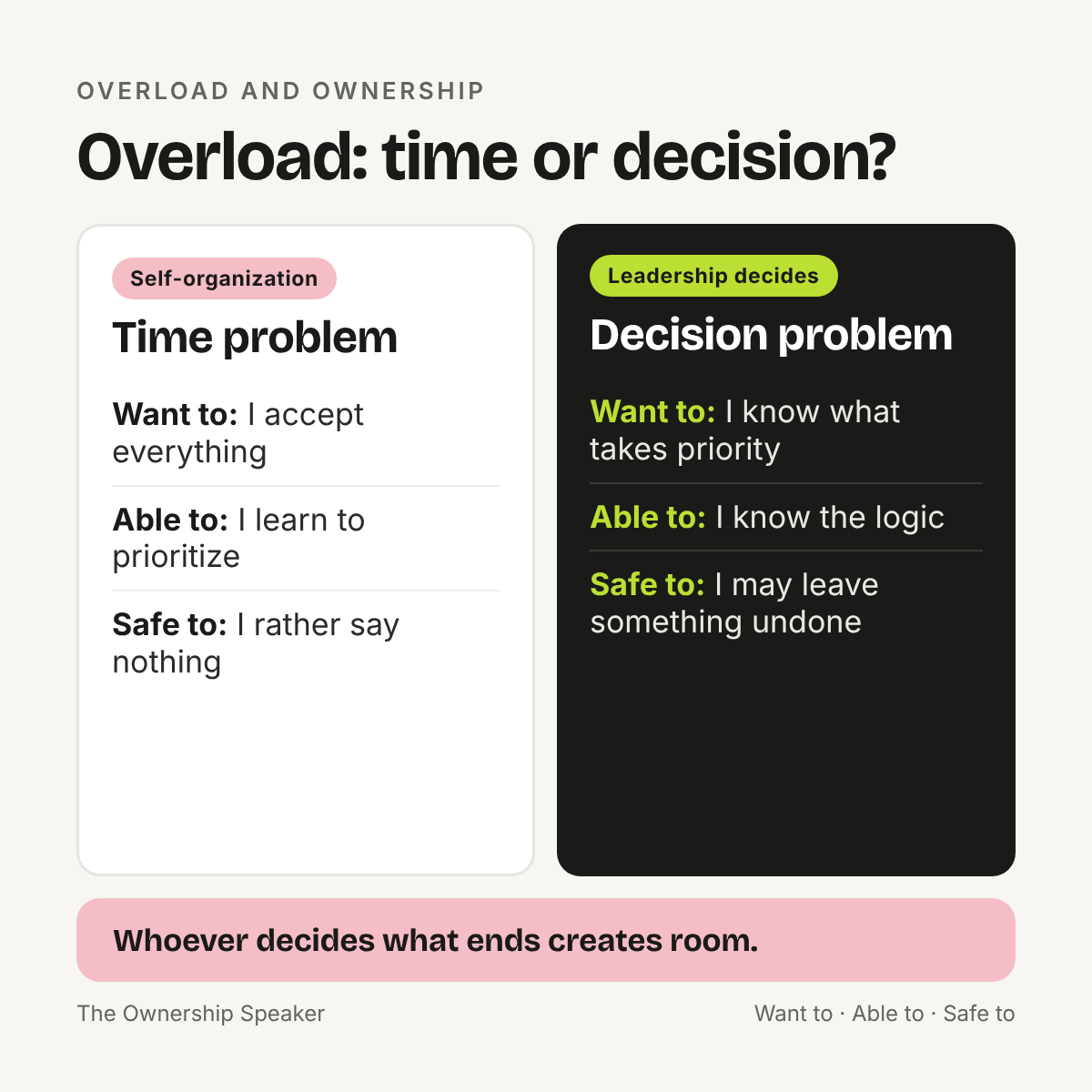
Time management advice does not repair a system that keeps adding new work, so the thesis goes, and I consider it accurate. Whoever receives additional tasks every month without anything ending can organize themselves as well as they like, in the end there is more work than time, and somebody has to decide what does not get done. The only question is who that is and whether it happens openly.
Through the ownership lens, overload is therefore not a topic of strain but a Safe to topic. As long as leaders do not decide what takes priority, employees decide it silently and at their own discretion, and they do so without the authority that such a decision actually needs.
Whoever does not decide what gets left undone passes the conflict down.
What happens when priorities are not spoken out loud?
Imagine an employee who finds three requests from three managers on her desk on a Monday morning, all marked as urgent. None of the three knows about the others, and whoever could tell her what takes priority is unavailable or will read the question as a sign of poor resilience. So she decides herself, and she decides by what promises the least trouble, not by what benefits the company most.
This mechanism is everyday and mostly stays invisible, because the result looks like normal work. Only when one of the three managers later asks why their topic was not done does the decision become visible, and then the employee bears the consequences of a choice she should never have had to make.
A team that experiences this repeatedly learns two things. It learns that priorities are a matter of negotiation between people and not a matter for leadership, and it learns that it is safer to accept as many requests as possible than to turn one down. Both produce overload, and both are rational.
Why are clear roles only half the solution?
The first countermeasure concerns roles. Employees should know what matters most and what good performance looks like, and for larger undertakings it should be settled at the start who is responsible for the undertaking and how to deal with uncertainty. Regular check-ins uncover confusion early, before it turns into extra work. A clear role is not a restriction, it is the foundation on which somebody can say no with reasons, without having to justify themselves.
What do leaders have to decide themselves?
The second measure sits one level higher. Leadership decides what takes priority and what can wait, and before new initiatives it clarifies at management level where they collide with existing commitments. That sounds obvious and is surprisingly rare in practice, because new initiatives usually have good arguments and nobody likes to be the one who says that something is not happening now.
Yet every initiative that is added without something else ending is a hidden decision for overload, and it is carried by those who did not take part in the decision. A manager who shies away from the decision hands the conflict down without handing down the authority to resolve it.
The difference between a manager who decides and one who distributes shows in a simple sentence. One says that something will wait and that she will stand behind that toward those who asked, the other says that the team should see how it copes.
What to do when the manager is overloaded herself?
The second source addresses managers who themselves have more work than their team can handle, and it shows a trap: Whoever carries the extra work personally risks burnout and withdraws attention from strategy, and whoever keeps burdening the team loses trust and high performers. The path in between begins with naming the resource problem, asking the team what can pause, and informing your own superior. Whoever does not do this turns their own overload into a private matter, although it is a question of the organization.
How do you make your decision logic transparent?
A further step from the same context appeals to me particularly, because it strengthens Able to in the team. The manager makes her decision logic transparent, that is, how she weighs conflicting goals, what good enough means to her right now and from when on she escalates. Whoever says this once saves the team a hundred follow-up questions, because employees can in future decide by this logic themselves.
This is the link to authority. A decision rule that has been spoken out loud gives people the possibility to act in the spirit of leadership without asking every time, and it makes visible when the situation changes and the rule has to be adapted. Without this disclosure every priority remains a guess.
Part of this is redistributing ownership. Where employees may delegate themselves or tasks are better placed with a more suitable team, the shift is not a sign of weakness but of clarity about who is responsible for what. And where deadlines are fixed, it helps to stay firm and then look together for a workable solution instead of quietly softening deadlines.
Where does the friction lie?
Both tips are aimed at managers who are overloaded themselves, and exactly there lies a friction. Whoever has no capacity themselves is supposed to create capacity for clarification, and that often succeeds only if the level above plays along. Advice that starts only at the lower management level merely moves the problem up by one step.
I therefore consider it more honest to say that overload cannot be solved by employees alone and not by the next management level alone. It is solved where somebody has the authority to end work, and that is almost always higher up than one would like.
How do you recognize that nobody decides in your area?
Anyone who wants to check this for their own area can start with a few questions.
Overload does not disappear when people are better organized, it disappears when somebody decides what ends and says so openly.
Sources
Reflections after reading the newsletter “The Management Tip of the Day” (Harvard Business Review, issues of September 23, 2026 and September 25, 2026). hbr.org
Ownership
Safe to
Prioritization
Leadership
Where does your organization stand on ownership?
The Assessment compares your organization with others and delivers concrete recommendations, not just a diagnosis.