October 15, 2026 · by Stephanie Selmer · 11 min read
A manager demands ownership from an experienced team but hands out half-thought-through instructions instead of goals and only passes on what she has grasped herself, so the team stays limited to her output. The case shows why ownership cannot be demanded, only made possible, and why the form of delegation has to fit the team.
There is a pattern I keep seeing in projects and recently experienced very clearly, namely that a manager demands ownership from her team but hands out individual tasks that she has only half thought through herself. These are island tasks that do not interlock and do not visibly contribute to the big goals the organization is currently facing and that everyone knows, and nobody learns where the whole thing is supposed to lead and how the pieces fit together.
The team is still supposed to take over responsibility, above all where the specification was easy, while the difficult questions stay open and nobody names them.
Anyone who is not allowed to show a gap upward cannot do so anywhere else either.
The simple part is done, the complex part is missing
The manager in this case believes she has thought her work through, and for the simple things that is true. She has, for example, specified what something should look like, in which order it happens and who gets what, and she assumes that this takes care of the essentials, because in her view the rest will take care of itself with AI or standard tools.
The complex part is not missing because she did not want to think it through, but because she lacks the view of it. Anyone who oversees little also does not see what they do not oversee, and therefore does not know the complexity behind the simple part. She cannot think it through because she does not even know there is something to think through, and so she takes the half-finished for finished. This is not a flaw of character but a consequence of missing expertise, and an experienced team recognizes the gaps immediately, and this is where the real tension begins.
On top of that, the individual tasks do not add up to a recognizable whole. They do not interlock and do not contribute to the big goals that everyone in the organization knows. Anyone who asks about the purpose of a task gets either no answer or one that does not withstand the next follow-up question. Without the where to and the how the whole fits together, nobody can judge what is important about their task, and ownership needs exactly this orientation, because you can only take responsibility for something whose place in the whole you understand.
The jump into details is a safety behavior. A detail can be checked and corrected, an overall picture cannot, and anyone who does not securely master the overall picture holds on to what they can control. For the team this means it gets too much of the wrong thing and too little of the right thing, and that the freedom ownership needs is missing exactly where experience would matter.
Over time the gap in expertise turns into a human one. The team notices that she does not see the complexity, that tasks do not hold up and that questions lead nowhere, and it begins to take her seriously no longer just on the subject but altogether. A team that considers its manager professionally overwhelmed listens differently, asks differently and gives her less credit of trust, and she feels it. This is what makes the situation so difficult, because a gap in knowledge can be closed, while a loss of respect can hardly be.
Two ways to delegate
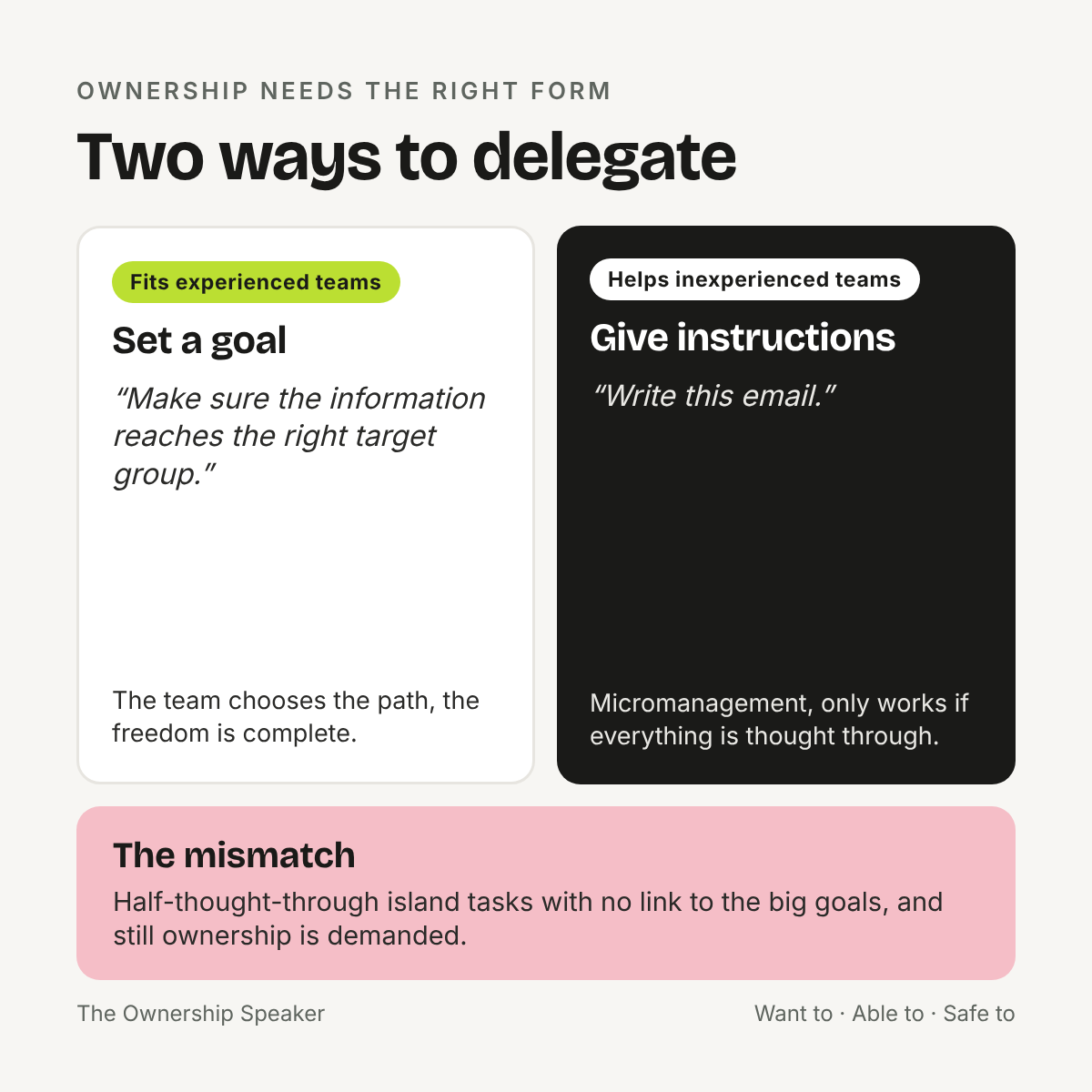
There are basically two ways to hand over work. In the first, a goal is handed over, so not “Write this email” but “Make sure this information reaches the right target group”, and the team decides on the path. For an experienced team this is the fitting form, because it leaves complete freedom.
In the second, the manager gives instructions that she has thought through completely, and the team works through them. This is micromanagement but can be helpful for an inexperienced team. There are many gradations between the two forms.
It becomes problematic when the form does not fit the team, when the thinking behind the instructions is missing or when the individual tasks do not add up to a recognizable whole.
When the team becomes the bottleneck
The manager is herself under considerable pressure, and in this situation statements like “I did not understand that” or “I do not know that yet” are not permitted. So she passes on the unfinished as if it were finished, and together with the task hands her own uncertainty downward, without anyone naming it as such.
On top of that, she only hands over what she considers herself to have grasped and keeps everything else to herself for the time being. The team is thereby limited to the output of a person who has little experience in this field and does not have her own area of work under control, and it waits for pieces that are small because they only contain the simple part.
This intensifies the pressure, because the longer the manager holds back, the less time remains for the complex part that in the end still has to be handed over, mostly late and again only half thought through. The team could achieve more than it gets, and the bottleneck is the person who feels the pressure most.
Anyone who has no room to admit a gap cannot leave room for it to others either, and so Safe to has already broken on the first level. In everyday life this shows in decisions remaining open and still being treated as if they had been made.
Where Safe to in the team leads nowhere
In the team, by contrast, Safe to is present. The people have experience, they recognize weaknesses and say so, which is lived ownership in the best sense, because anyone who asks follow-up questions wants the result to be good. The problem lies in where the objection falls.
The manager experiences follow-up questions about quality, and even the question about the purpose of a task, as an attack, because they touch the only support she has left, namely the appearance that what was passed on is right. The answer is sharpness, later open counterattack and finally escalation upward instead of resolving the conflict in the team.
This puts a price on objection, and the team learns quickly that whoever speaks up gets trouble and whoever stays silent gets peace.
How Want to tips over
Want to is not the cause in this pattern but the consequence. The poorer the information, the longer the team waits for pieces and the more often it happens, the less it pays to do anything at all, and motivation does not drop because people did not want to, but because wanting does not pay off.
That is why the appeal to please take responsibility does not help. It addresses Want to although the cause lies in Able to and Safe to, it demands ownership in a form of delegation that does not allow it at all, and the team rightly hears it as an imposition, because it shifts the problem onto the people who caused it least.
Added to this is a quiet side effect, because the people who think along the most withdraw first, as they ask follow-up questions most often and therefore pay the price most often.
A situation, not a question of character
That the manager has little experience in this field is not the core of the problem but the condition under which the pattern becomes visible. Organizations often put people into roles in which they are expected to lead immediately although they lack the time to get to the bottom of the subject, and at the same time they experience leading a team that knows more than they do.
In this constellation there are two ways out, both of them human. You can admit that you have to learn, and for this she herself in turn needs leadership that allows learning, or you can create safety by exercising control and fending off every follow-up question. Which path someone takes depends less on character than on what the environment allows them, and that is why the question of whether an organization can tolerate gaps is a leadership question and not a question for the individual.
What can be made possible
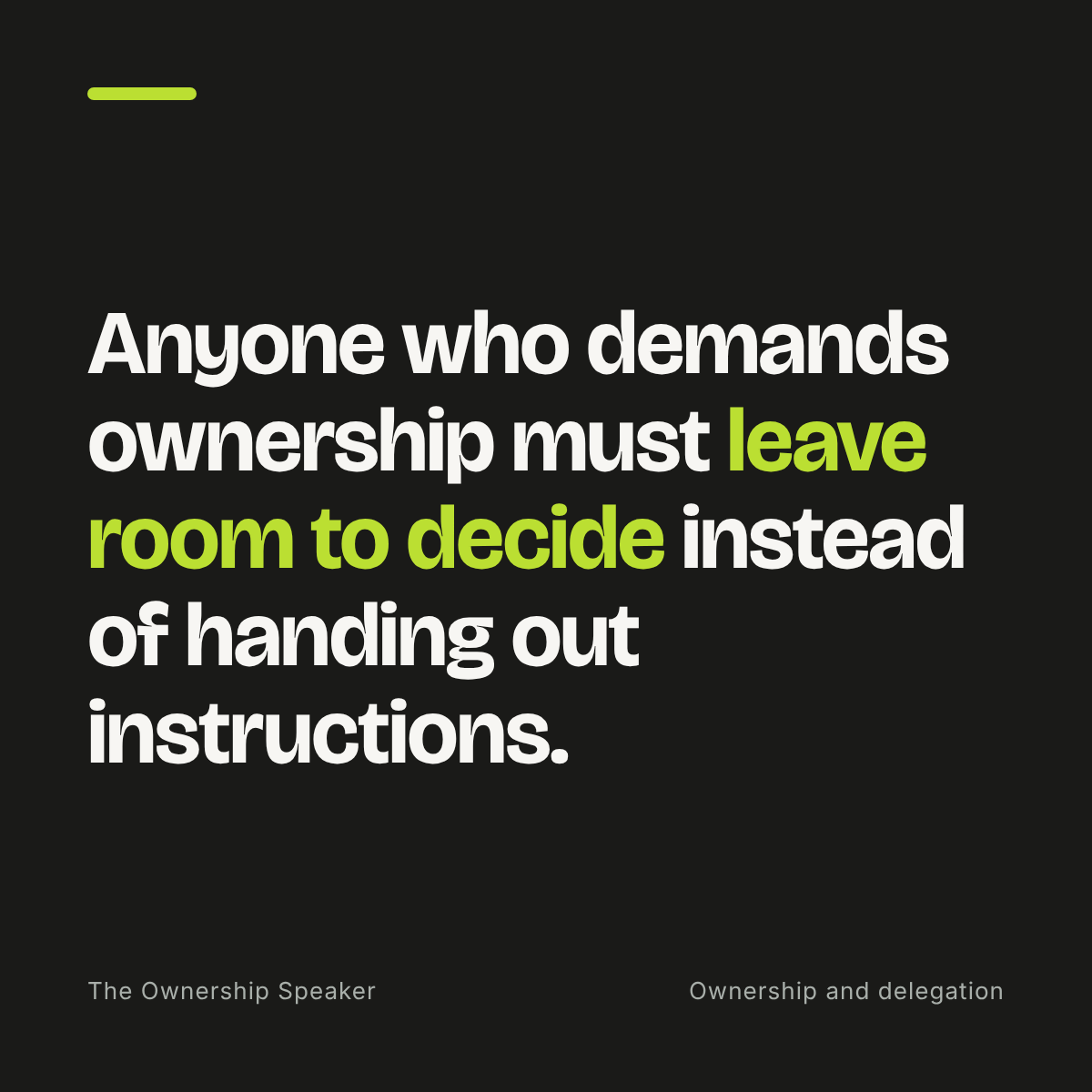
Ownership cannot be demanded, it can only be made possible, and for this it takes above all a form of delegation that fits the team. An experienced team needs the goal and the freedom to choose the path itself, not fully thought-out instructions. An inexperienced team needs more guidance, but then real guidance, where the thinking behind the instructions also holds. The worst combination is the one in which half-thought-through instructions are handed out and ownership is demanded at the same time.
This includes honestly assessing what you have grasped yourself and handing over the rest as a goal instead of holding it back until it feels safe. Anyone who only hands over what they have fully thought through makes themselves and the team the bottleneck, and anyone who hands over the goal uses the experience that is already in the room. Follow-up questions have to be endured, including the uncomfortable ones, and thinking about quality must not be punished, because otherwise Want to breaks away exactly where it is needed most.
For the manager in this case this is a high demand, because she herself would need a space in which she may admit a gap. Psychological safety runs through organizations from top to bottom, and where it breaks in the chain, the break continues downward. This explains the behavior without excusing it, and it shows that responsibility for this space also lies with those above the manager.
In concrete terms this means clarifying three questions with every handover, namely which effect is to be achieved, how it contributes to the big goals of the organization and which other tasks it connects to, and which decisions the team may make without asking. Anyone who can state the goal in one sentence can hand over without knowing the path, and for people who are under pressure and do not yet oversee everything, this is often the most relieving way.
What a team can do in this situation
A team cannot dissolve the pattern on its own, but it can limit the damage. It helps to make assumptions visible by writing down what you are assuming and asking for correction, instead of questioning the task fundamentally. It also helps to ask about the goal behind an instruction, because anyone who knows the desired effect can take responsibility for the path. Follow-up questions can also be bundled and given their purpose, so that they are understood as a contribution to the result and not as criticism of the person.
It is also important to involve the level above early and openly, before the conflict arrives there without the team knowing about it. And it helps not to want to win the argument, because anyone who exposes the manager reinforces exactly the fear from which the behavior arises.
Questions about your own stance
The pattern does not only affect managers in difficult situations, it can happen to anyone who delegates, and those who want to check it for themselves can begin with a few questions.
Anyone who wants ownership should start with their own handover and not with the will of others, because there is usually less lack there than in the question of whether the team received a goal or only instructions to work through.
Sources
Experience from consulting practice, anonymized and altered.
Leadership
Ownership
Delegation
Psychological safety
Where does your organization stand on ownership?
The Assessment compares your organization with others and delivers concrete recommendations, not just a diagnosis.