September 30, 2026 · by Stephanie Selmer · 8 min read
Many organizations try to create responsibility through more pressure, and are then surprised by work to rule, silence in meetings and mistakes that only come to light once they have become expensive. Amy Edmondson's model of the four zones explains why this happens, and it shows that ownership emerges exactly where high standards meet psychological safety.
Amy Edmondson, professor at Harvard Business School, has been researching since the 1990s why some teams learn from mistakes and others hide them, and her central concept for this is psychological safety. It means a team's shared belief that it is safe to take interpersonal risks, that is, to ask a question, admit a mistake, suggest an idea or disagree with a manager's proposal, without being embarrassed or devalued for it. At first this has nothing to do with being nice, but describes a condition for information to arrive where decisions are made.
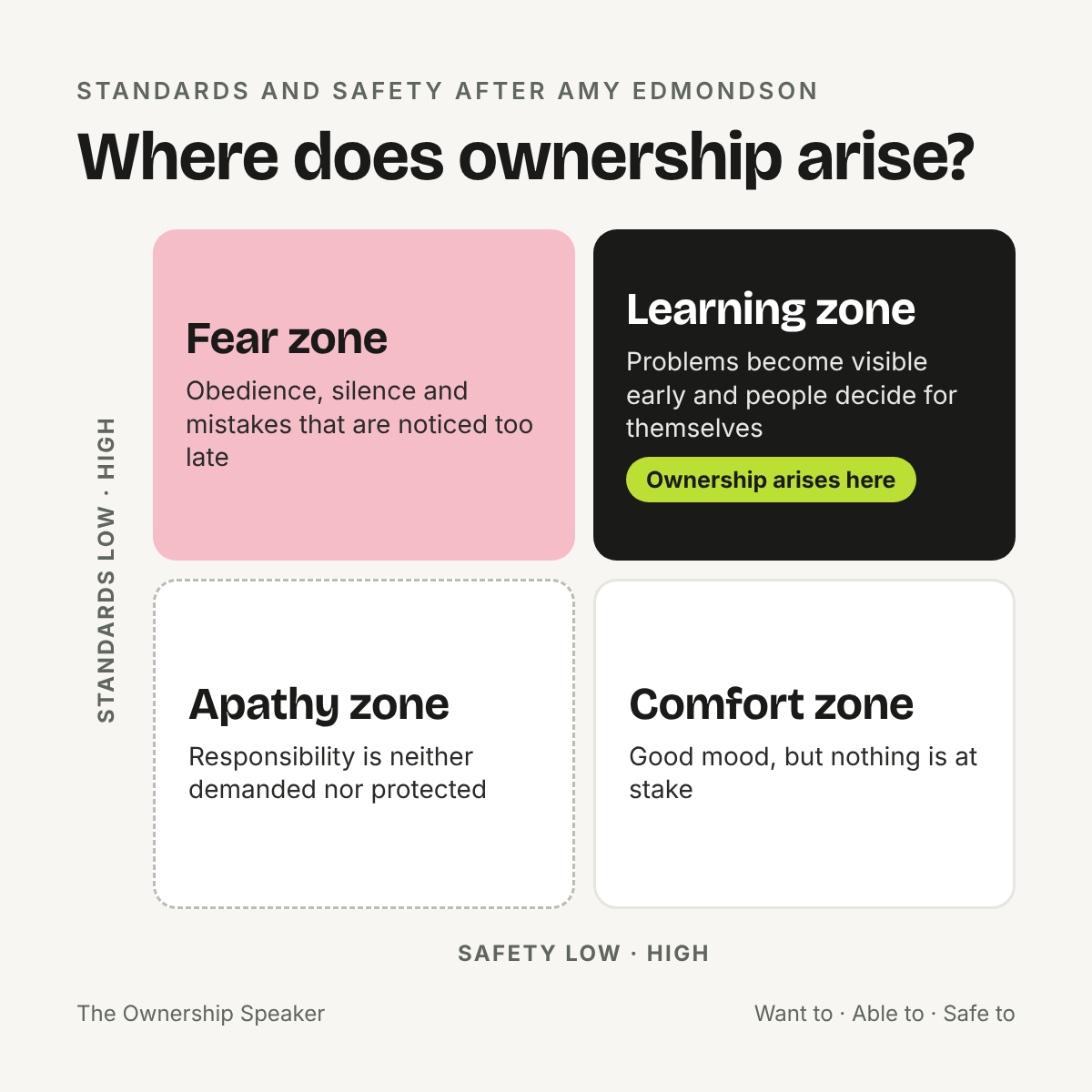
Edmondson sets this psychological safety against a second factor, namely the standards an organization sets for performance and results. If you view the two as the axes of a quadrant, where one axis describes safety and the other the drive, that is, the degree to which people are challenged, four zones result that are surprisingly easy to recognize in everyday work.
Four zones and what happens to responsibility in them
In the apathy zone both safety and standards are low, and the result is a work culture in which people do exactly what the job description says, because nobody expects more of them and nobody reacts when they do more. Responsibility is not an issue here, because it is neither demanded nor protected.
In the comfort zone safety is high but standards are low, which feels pleasant at first, because conflicts are rare, the mood is good and nobody is under pressure. The problem only shows on a second look, because where nothing is at stake, there is also nothing to take responsibility for.
In the fear zone standards are high and safety is low, and many people experience exactly this combination in transformation projects with tight deadlines, ambitious goals and the unspoken expectation that problems are solved and not reported. People deliver as long as they are being observed, they avoid every visible risk, and they only raise difficulties when these can no longer be hidden.
Only in the fourth zone, referred to as the high-performance zone or also the learning zone, are safety and standards high at the same time. This is where what many organizations are looking for emerges, namely people who take their tasks seriously, make problems visible early and make decisions without asking for permission three times first.
Why pressure alone only produces obedience
Ownership means that people stand up for a result as if it were their own, and this presupposes that they are willing to take a personal risk, namely the risk that something fails and falls back on them. In the Ownership Triangle this can be read off three conditions that must be met for responsibility to emerge, namely that people are able to do something, that they dare to do it and that they want to do it. The fear zone offers an instructive example, because there the abilities are often present and the standards are high anyway, but Safe to is missing, because every decision means a risk for one's own position, and where Safe to is missing, Want to withers as well.
This dynamic is now well documented. As part of Project Aristotle, Google analyzed the data of 180 teams and concluded that psychological safety was the most important of the five factors examined for a team's effectiveness, ahead of clear structures, reliability, meaning and impact. This refutes the widespread assumption that safety and performance stand in tension, and it explains why programs that rely solely on targets and control so often fall short of their expectations.
The comfort zone is the most dangerous because it feels good
The fear zone is seen as the obvious problem because its symptoms are loud, namely overload, turnover and escalations, while the comfort zone stays quiet and is therefore easily overlooked. In organizations that deliberately focus on appreciation and consideration after a stressful phase, development occasionally tips into exactly this zone, because the pressure is rightly taken out, but the standards are unnoticeably lowered as well. The conversations become friendlier, the results become less binding, and nobody disagrees anymore, because disagreement is felt as a disturbance of the good mood.
Psychological safety, however, explicitly does not mean that everyone agrees or feels comfortable all the time, but that disagreement can be voiced without anyone having to pay for it. A team that avoids conflict therefore does not have too much safety, but a misunderstanding about what safety is, and it will find that ownership fails to appear where nobody risks anything.
Everything is an experiment
Edmondson describes three tasks for leaders, namely to set the stage, to invite participation and to respond productively to contributions. In everyday work, these tasks can be translated into four basic attitudes that look unspectacular at first glance: creating room to speak, modeling curiosity and asking questions, framing work as an experiment and admitting one's own mistakes.
Those who frame work as a learning problem rather than an execution problem turn every deviation into information.
Framing work as an experiment deserves particular attention, because it offers a perspective that is rarely chosen in change initiatives. Those who treat an undertaking as an execution problem assume that the path is known and only has to be implemented consistently, and any deviation then counts as an error by those executing it. Those who treat it as a learning problem, on the other hand, concede that much is unknown and invite everyone involved to treat deviations as information. Especially for changes with an open outcome, the second framing is not only friendlier but simply more realistic.
The fourth basic attitude, admitting one's own mistakes, is at the same time the most concrete form of lived ownership that a leader can show. Anyone who says publicly that a decision was wrong and what consequences they draw from it demonstrates that taking responsibility is something different from avoiding blame, and gives everyone else permission to do the same.
How contributions are responded to decides everything
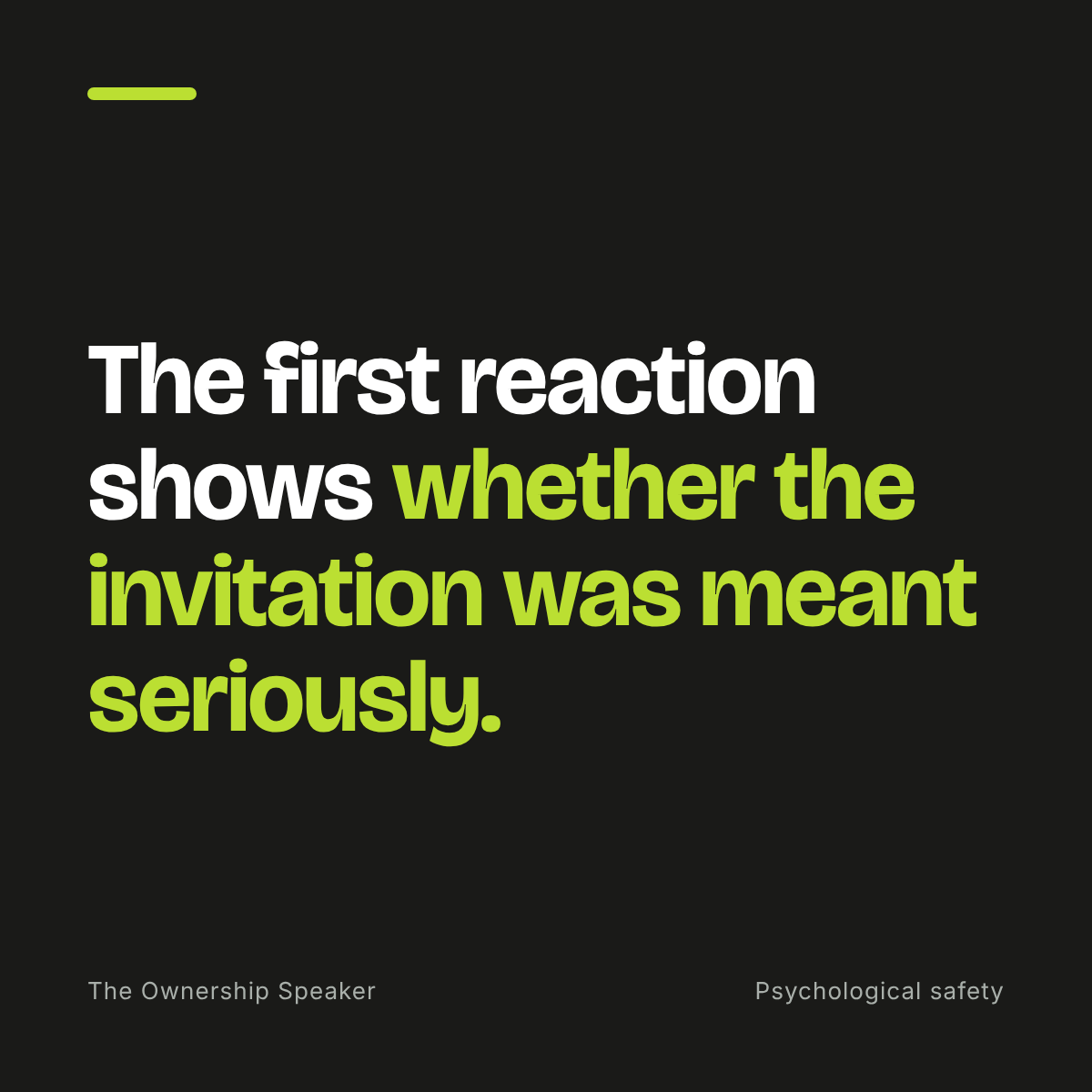
Edmondson's third task, responding productively to contributions, decides in practice whether the first two tasks take effect, because the invitation to questions and disagreement is only as credible as the first reaction to it. Anyone who justifies themselves at the first critical feedback, reacts with annoyance or postpones the topic until later has shown within a few seconds that the invitation was not meant seriously, and this experience gets around in teams surprisingly fast.
More helpful are reactions that acknowledge the courage, put the problem rather than the person at the center and clarify together what to do next. At the same time, a productive reaction includes that clear rule violations have consequences, because safety without commitment leads back into the comfort zone.
A typical scenario from change initiatives
Imagine a program that is to introduce a new way of working at several sites and whose schedule was fixed by the executive board. The project management reports a status every month, the traffic lights are green, and the steering committee is satisfied, until shortly before the planned start it turns out that the technical prerequisites are not in place at two sites. In hindsight, such cases often show that individual participants had known about the problem for weeks but had not reported it, because the schedule was considered immovable and bad news could look like personal failure.
In such a situation, it was not competence or good will that was lacking, but an environment in which an early warning would have been treated as a contribution and not as a disruption. Those who then order more control, more reports and tighter deadlines move the organization even deeper into the fear zone, while the path to ownership leads through the question of how reporting a problem feels for the person who reports it.
What this means for change initiatives
For those responsible for change, the quadrant yields a simple but uncomfortable diagnosis that can be checked with a few questions. Those who want to know which zone a team or an entire area is currently in can ask the following questions and compare the answers with observations from everyday work.
The answers usually show quickly whether the actual obstacle is missing standards, missing safety or both at once, and they prevent additional communication measures from being deployed where what is really needed is a change in how leadership reacts. Ownership can be neither ordered nor talked into existence through campaigns, but it can be enabled by creating conditions under which taking responsibility is less risky than avoiding it.
Sources
Edmondson, Amy C. (2018): The Fearless Organization. Creating Psychological Safety in the Workplace for Learning, Innovation, and Growth. Hoboken: Wiley.
Edmondson, Amy (1999): Psychological Safety and Learning Behavior in Work Teams. In: Administrative Science Quarterly 44 (2), pp. 350 to 383.
Google re:Work: Understand team effectiveness (Project Aristotle). rework.withgoogle.com
psychsafety.co.uk: Posters “The Psychological Safety Comfort Zone Quadrant” and “The Three Fundamentals of Psychological Safety” after Amy Edmondson (2018), illustration deisatremarias. psychsafety.co.uk, behance.net/deisatremarias
Psychological safety
Ownership
Amy Edmondson
Change
Where does your organization stand on ownership?
The Assessment compares your organization with others and delivers concrete recommendations, not just a diagnosis.