November 20, 2026 · by Stephanie Selmer · 7 min read
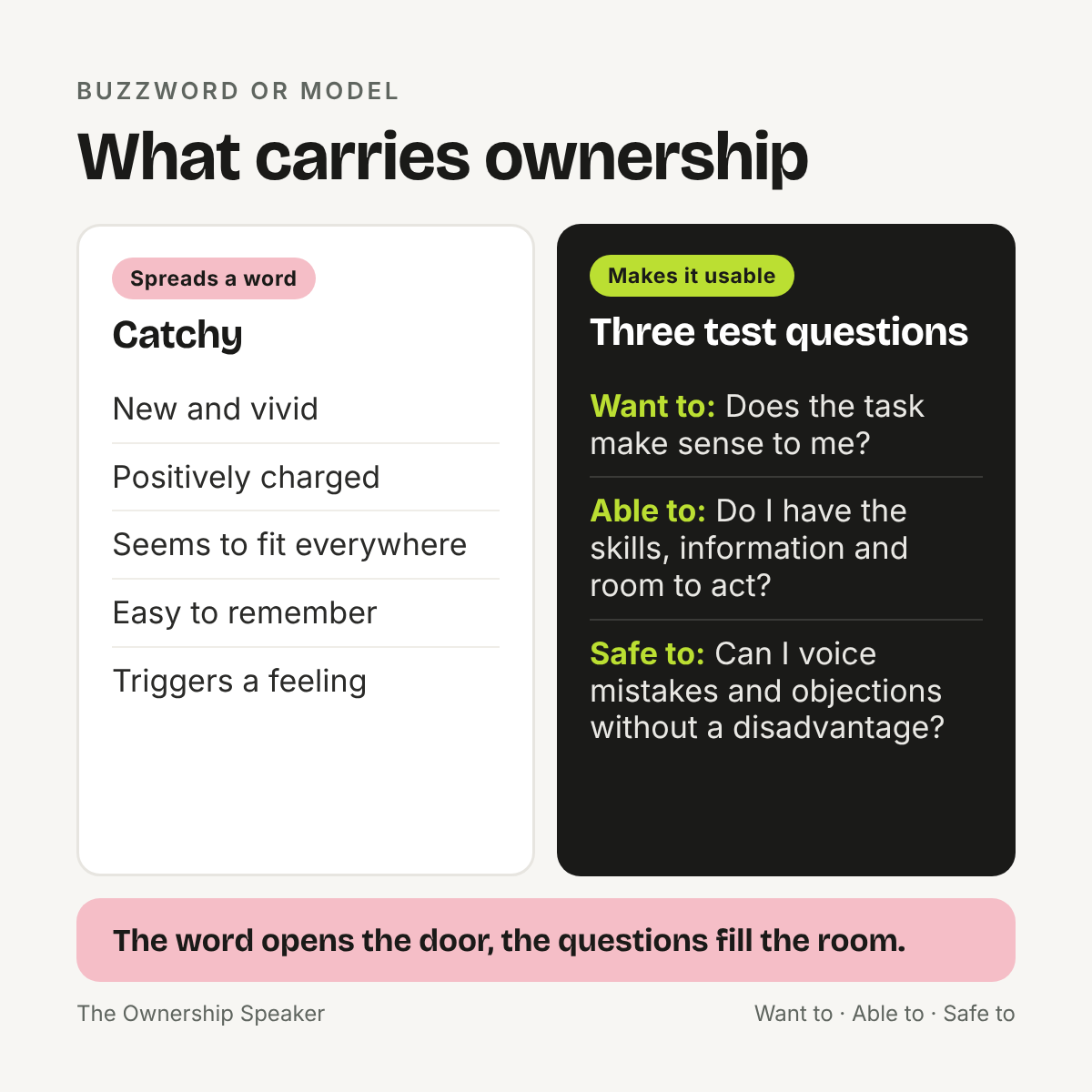
Ownership is a word that spreads easily because it sounds catchy and positive, and in the process usually only Want to remains while Able to and Safe to drop out. A term only stays useful if it can be tested, and for ownership this works through the three questions about Want to, Able to and Safe to.
In job ads, mission statements and leadership programs the word ownership appears more and more often, and each time it sounds a little different. Sometimes it means personal responsibility, sometimes entrepreneurship within the company, sometimes simply that someone takes care of things, and sometimes it only means that tasks are pushed downward. This is not surprising, because terms are not chosen for their precision.
Create a photorealistic image in 3:2 format: A wall full of colorful sticky notes with crossed-out buzzwords, in the middle a single empty white note that stands out, side daylight, main subject in the center, no stock photo look, no text in the image.
I consider this development a chance and a danger at the same time, and both hang on the same point, namely that the word is catchy.
In a mission statement ownership can be written down, whereas in a project it has to emerge, and between the two lies the actual work. The better known the word becomes, the greater the danger that the two are confused and that a mention in the mission statement already counts as done.
A term everyone understands changes nothing as long as everyone means something different.
What is left of ownership when the word travels?
Terms do not catch on in organizations because they are precise but because they are vivid, positively charged, easy to remember and seemingly applicable everywhere, and ownership meets all of these conditions. On its way from mouth to mouth a term gets shortened, and the question is what falls by the wayside with ownership.
Usually it is Able to and Safe to. What remains is Want to, the attitude of feeling responsible, because it can be demanded, written into ads and poured into mission statements. That people also need skills, information and room to act, and the certainty that mistakes and objections will not be punished, fits a slogan less well and drops out first. In this way a model with three prerequisites becomes an appeal with one.
For organizations this is uncomfortable, because the spread of the word is then no proof of its effect. That many leadership programs pick it up says nothing yet about whether anything is happening there that lets people actually take responsibility.
Why does even criticism spread a term?
Even criticism contributes to the spread, because every critical mention is another repetition of the term. Whoever gets annoyed by a buzzword names it, and whoever wants to refute it makes it better known, so that attention is the currency and not agreement. This applies to supporters and skeptics alike, and both keep the term in circulation. Attention acts like an amplifier that does not ask whether it was meant kindly.
For ownership this means that the word will keep spreading without any help from us, with or without substance. The question is not whether it becomes a buzzword but whether something stands behind it when it does. This dynamic cannot be stopped, but it can be accompanied with content.
What happens when ownership becomes a label?
A label without a definition invites misuse. When ownership is demanded without anyone saying what is meant by it, the word becomes a request to take on more responsibility without anything changing in the conditions. People are supposed to feel responsible for things they are not allowed to decide, with information they do not have, in an environment in which mistakes are expensive.
Then what happens to every overstretched term happens, it loses its value. People hear it and roll their eyes, managers use it as a blanket answer to problems that have entirely different causes, and the legitimate idea behind it is devalued along with it.
Added to this is a mechanism known from other fashionable topics. As soon as a term is considered important, everyone wants to own it, and programs, trainings and campaigns adopt it without examining the conditions under which it can work. The word then wanders from slide to slide while the everyday life of the people hardly changes.
Particularly tricky is the confusion of ownership with responsibility for results. Whoever is responsible for results without having influence over the means carries a burden but not ownership, and it does not help to name the burden more kindly.
How can ownership be tested?
A term stays useful if it can be tested. For ownership this works through three questions that every person asks themselves about every task: Does the task make sense to me? Do I have the skills, information and room to act? Can I voice mistakes, objections and decisions without it harming me?
Where one of the three answers is missing, ownership is not there, no matter how often the word is used. The model turns a mood term into a diagnosis, and a diagnosis can be discussed, checked and refuted. This test works for a whole team just as for individual people, except that the answers within a team often diverge, and these very differences show where to start.
Can catchy and precise be combined?
At this point I do not want to fight the dynamic of the spread but use it. A catchy word is an advantage if you give it a precise meaning, because it opens the door, and behind it stands something that holds. The problem arises only when the door is open and the room behind it stays empty.
Modesty about reach also helps. A model does not explain everything, and whoever declares ownership a universal key makes the same mistake as those who use the word emptily, only with more substance. It is better to say clearly what the model is good for, namely recognizing what is snagging in a concrete situation, and what it is not good for.
In practice this means never using the term without its test questions. Whoever demands ownership should be able to say in the same sentence how to recognize it, what the prerequisites are and who has to create them, and whoever cannot do that should choose another word.
Another protection against arbitrariness is examples that tie the term to concrete behavior. A person who objects in a meeting and is heard shows more about ownership than any definition, and a person who stays silent because speaking up does not pay off shows more about its absence than any questionnaire.
How do you check the use of the word in your organization?
If the word is already in circulation in your organization, it is worth checking once what is meant by it, and a few questions are enough.
The first question alone often delivers more insight than any campaign, because the answers frequently diverge widely, and this is exactly the sign that the word does not yet carry.
Does a buzzword have to be fate?
I do not think so. A word that spreads quickly has the advantage that people know it and gladly pick it up, and that is more than many important concepts ever achieve. What matters is what happens to it in the meantime, whether it is filled with content or whether it stays empty and waits for the next fashion.
And whoever wants to decide for themselves whether the word still carries in their organization does not need a study for it, but a few honest conversations and the willingness to endure the answers, even when they turn out uncomfortable.
Whoever takes ownership seriously should therefore talk less about how important it is and more about what a person needs in order to take it on. Then something remains of the buzzword, namely a question that can be asked of every task.
Sources
Reflections after reading the newsletter “Psychological Safety” (issue 281, October 2026). psychsafety.com
Ownership
Want to, Able to, Safe to
Communication
Organizational development
Where does your organization stand on ownership?
The Assessment compares your organization with others and delivers concrete recommendations, not just a diagnosis.