
In an anonymous post online, a temp worker in a sorting center describes a job that includes taking out letters and parcels with too little postage on them, and reports applying this rule unevenly.

Story
A temp worker in a sorting center lets underpaid mail from people in need pass and consistently pulls the letters of large companies, and calls this Robin Hood. The case shows what a willingness to take responsibility looks like when nobody has assigned it and nobody appreciates it, and what organizations can learn from it about their unregulated room for discretion.
In an anonymous post online, a temp worker in a sorting center describes a job that includes taking out letters and parcels with too little postage on them, and reports applying this rule unevenly.
Items that obviously come from people in a difficult financial situation, which the worker recognizes for example by the fact that they are addressed to social organizations, are let through, while envelopes from large companies with too little postage are pulled without exception. By their own calculation this costs the employer about twenty euros a day, and they feel like Robin Hood doing it, because they spare people unnecessary stress and at the same time get even for poor working conditions and disrespectful supervisors.
The reactions below the post are mostly approving, and several commenters advise continuing and telling nobody under any circumstances. Only one voice objects that the comparison with Robin Hood is bold because no life is at stake here, and this objection clarifies a few things that the question of good and evil alone cannot.
The discretion was never granted, so someone took it.
At first glance the temp worker brings everything that leaders wish for in their people, because they look closely, decide for themselves, care about something beyond their own task and carry something for others. Anyone who measures ownership by visible behavior would probably name them as an example, and this is exactly where the story becomes uncomfortable.
Ownership in the sense of Want to, Able to and Safe to presupposes that someone stands up for a result that was entrusted to them and can deal with it openly. The temp worker stands up for a result that nobody asked of them, namely that people in need are not asked to pay extra on top of everything else, and does so covertly, with the explicit intention that the employer does not notice. The willingness to take responsibility is there, it is just attached to no assignment and no backing.
This is no coincidence but a pattern that appears in many organizations, because where the assignment is narrow and appreciation is missing, the willingness to take responsibility looks for another target, and that target then no longer lies where the organization needs it.
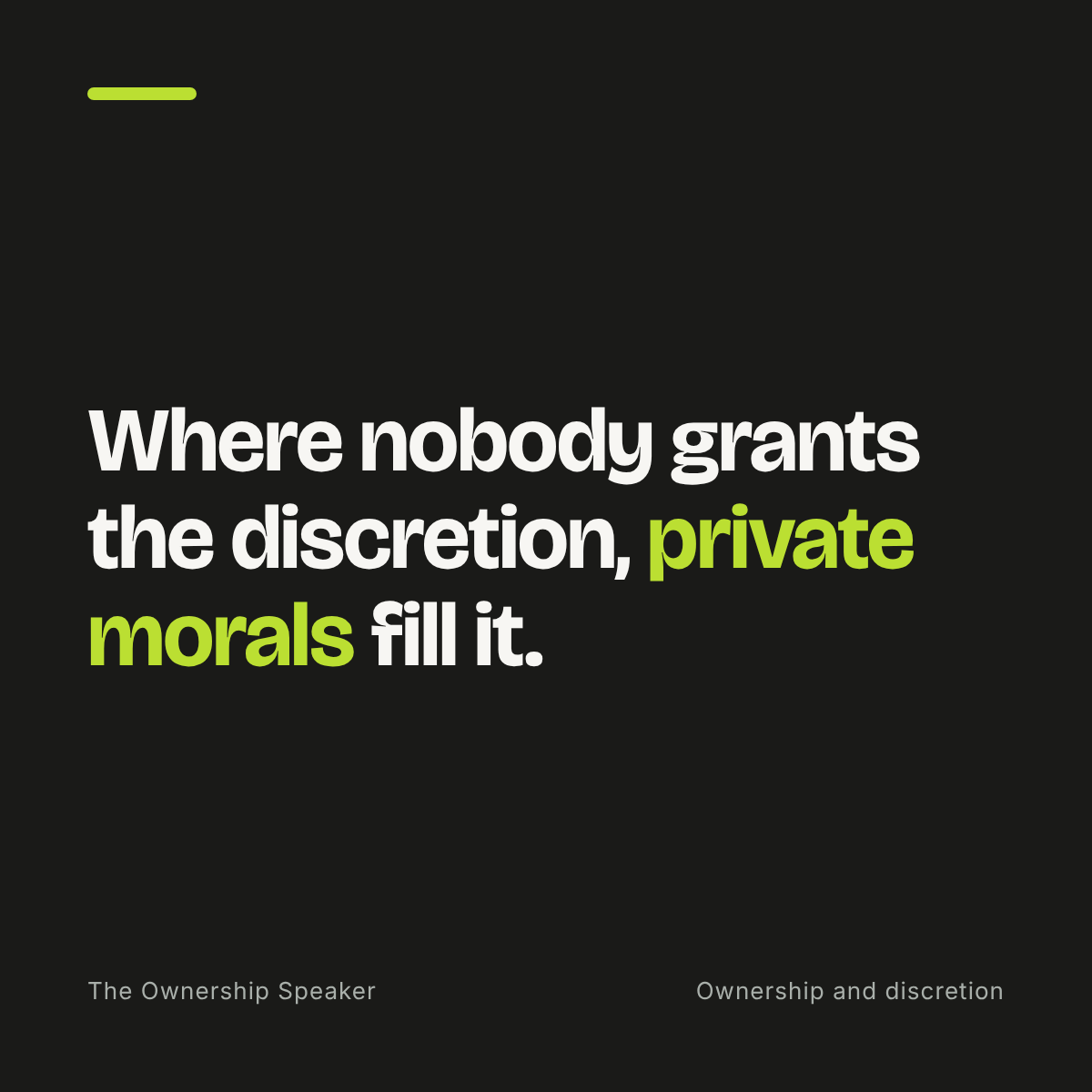
Pulling mail means checking, and checking means judging, yet nobody has told the temp worker how far this judgment reaches and whether there are cases in which a rule may be applied with a sense of proportion. They stepped into this gap, and such gaps exist in every organization even if they rarely come to light so clearly. They lie in the question of which request is handled first, which mistake is treated leniently and which email is forwarded or left lying, and they are larger the more people work alone. As long as nobody names them, they are filled according to the morals of the person involved, and that can lead to decisions that one can understand and still did not want.
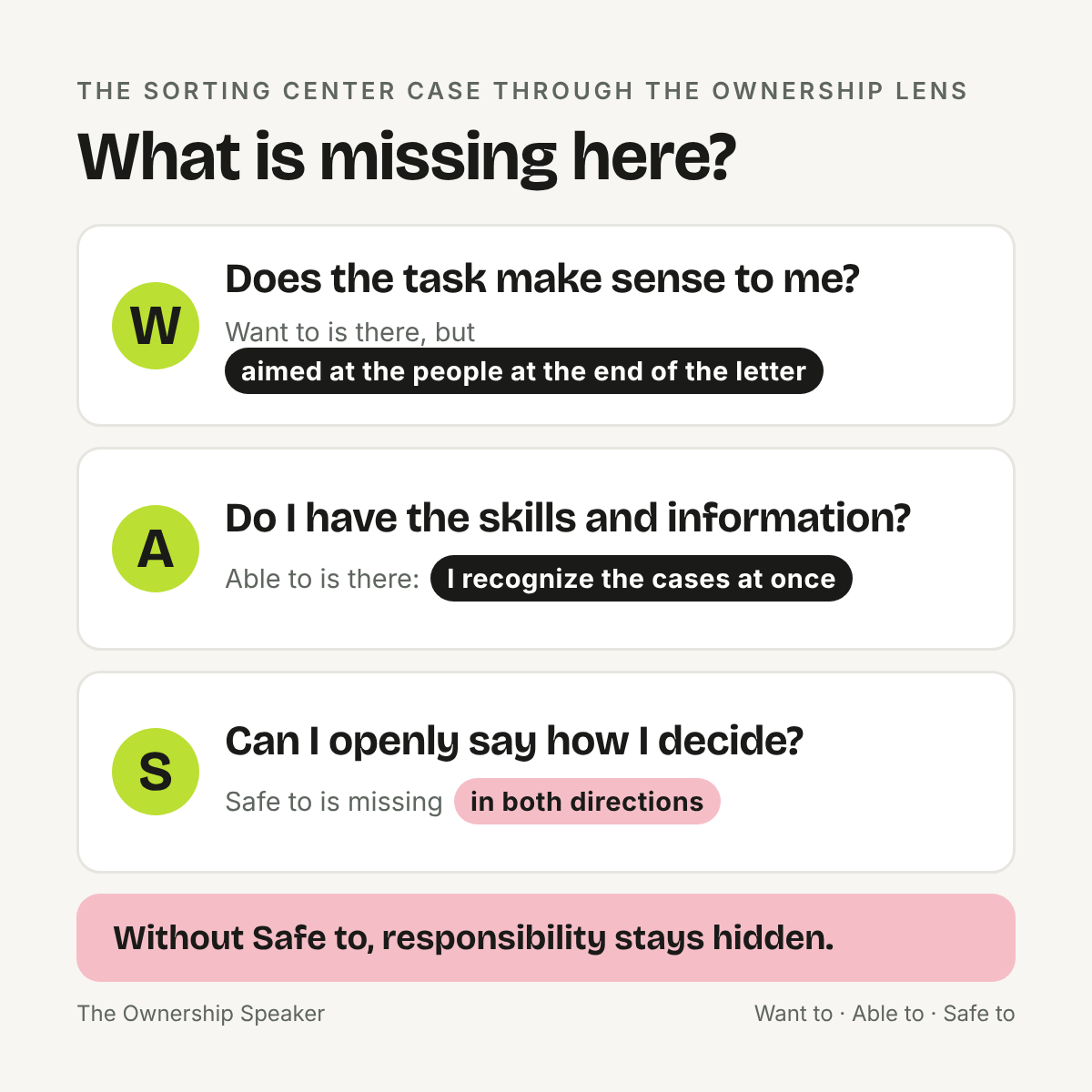
Able to is present, because the temp worker recognizes very precisely who can afford to pay extra and who cannot, and has enough experience with the task to know what they are doing. Want to is there as well, it is only aimed at the people at the end of the letters and no longer at the employer, because by their own account the employer gives no reason for it.
The gap lies in Safe to, and in both directions. The organization has visibly not trusted this person with anything, which can be read from the poor conditions and the missing respect, and the person in turn does not dare to use their discretion openly because they expect it to be taken away. That several commenters recommend telling nobody confirms this calculation, because anyone who considers an action right and still has to hide it has long since answered the question of whether it is safe.
Want to rarely arises from nothing, it depends on meaning and recognition, and when both are absent it does not disappear but looks for a new target. Disrespectful supervisors and poor conditions are the trigger in this story, and the target the energy then finds is compensation, because one harms the one who gives nothing and helps those who have done nothing wrong. That feels good because it returns the ability to act where there was powerlessness before, and that is why revenge here is less malice than an answer to missing appreciation. For the organization this changes little, since the damage occurs anyway, it is just caused by a person who was originally prepared to give more.
First, it means that the discretion exists whether leadership regulates it or not, and that somebody will always be found to fill it. The question is therefore not whether employees exercise discretion but by what standards they do so and whether these standards have anything to do with the purpose of the work. Where nobody says in which cases a sense of proportion is wanted, private morals decide in the end, and these can just as well relieve people in need as push a bill onto someone else.
Second, the applause is worth a look. That so many strangers encourage the temp worker is information, because obviously many people feel that the rule misses its purpose in these cases, and this is exactly what the organization would like to hear from the inside instead of reading it off the damage. Someone who acts in secret receives approval from strangers and never from their own leadership, and so the company loses a hint it might urgently need.
Third, appreciation affects not only mood but the direction of energy. Those who experience that their observations are welcome contribute them, and those who experience that they count for nothing keep them to themselves or act on them as they see fit.
I would distinguish between the two without judging the temp worker, because their concern is understandable and so is their situation. For me ownership means standing up for a result that was entrusted to you and representing your own decisions openly, even when they are uncomfortable. Acting on one’s own authority begins where someone makes decisions they would not defend in front of those responsible, and hiding is its telltale sign.
The objection that no life is at stake here therefore concerns structure more than morality, because whether a concern is big enough to bend a rule must be decided by someone who is responsible for it. The comparison with Robin Hood is thus not wrong but incomplete, because the legend includes that he openly bears the consequences of his deeds, while here they stay hidden, and exactly there lies the difference between a deed and ownership. Both can arise from compassion, but only one of them can be shared by others.
A simple test is whether the person would tell their own manager about what they do, and in this case the answer is already in the post. The fatal thing is that someone who secretly takes discretion can never be given it openly, because the question of whether it is theirs was never asked. The way out therefore lies not in more control, which would only reinforce the hiding, but in a conversation about where a sense of proportion is wanted, with clear limits and a person who stands behind it.
Anyone who wants to check this for their own area can start with a few questions.
Anyone who grants discretion explicitly gets back, in the open, the responsibility that was there anyway.
The Assessment compares your organization with others and delivers concrete recommendations, not just a diagnosis.
Start the Assessment