Those who hesitate may have understood the role best
October 30, 2026 · by Stephanie Selmer · 6 min read
Enthusiasm counts as readiness and hesitation as a deficit, yet both can be misleading. The article asks what hesitation reveals about Want to and what organizations use to decide whom they trust with responsibility.
When someone is proposed for a leadership role and does not say yes right away, a quiet suspicion arises in many organizations, namely that the person lacks ambition or self-confidence. In the Harvard Business Review newsletter I read a counter-thesis that makes sense to me: Whoever hesitates may understand the demands of the role better than someone who agrees enthusiastically on the spot.
Enthusiasm looks like readiness because it is visible, and hesitation looks like doubt because it is quiet, but at first both say something about expression and little about suitability. Anyone who knows how much time away from the specialist field, how many difficult conversations and how much responsibility for other people’s results come with a leadership role has good reasons not to give the answer in the first moment.
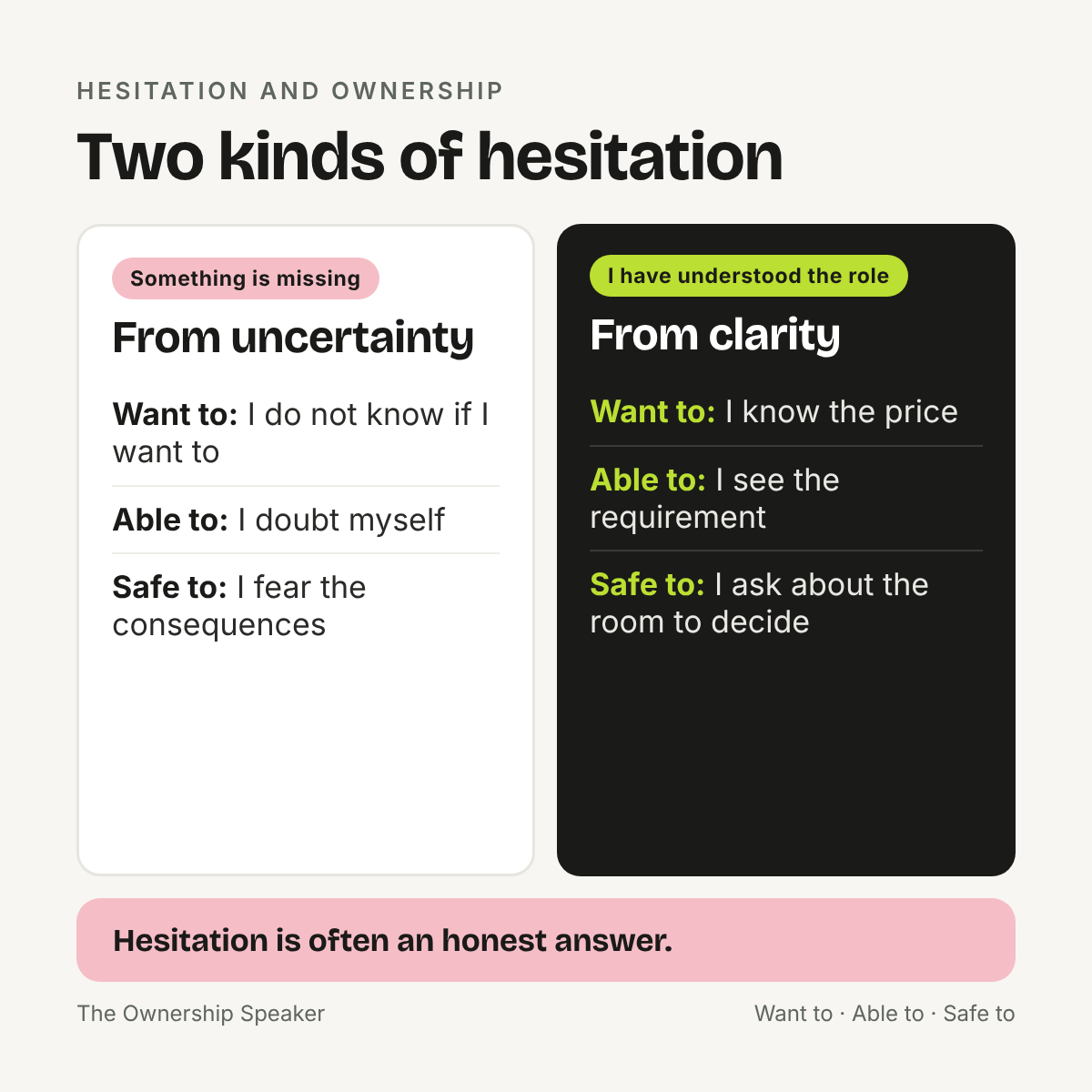
Through the ownership lens this is a Want to question that deserves to be taken seriously. Ownership arises when someone wants to, is able to and feels safe to, and hesitation can be exactly the check that this Want to carries out before a decision. Whoever skips it and persuades gets, at best, a borrowed yes.
Hesitation is often the most honest form of Want to.
What is behind the hesitation?
Hesitation has different causes, and they call for different answers. Some people are attracted by the role but fear that they will not live up to its demands, and here support helps, because doubts about one’s own abilities can be resolved with accompaniment, practice and feedback. That is an Able to topic and a good one to work on.
Others simply have no interest in leading people, they like their field, their impact there and the freedom that comes with it, and for them the promotion is a trade that they do not want to make. That is not a deficit but an answer, and overhearing it usually costs the organization more later than the candidate it loses.
What matters is that in the conversation you want to understand rather than persuade. Ask what appeals, what would have to be given up, how much time away from the specialist field is imaginable and what support would be needed, and listen to the answers before you argue. Whoever feels understood talks about the real reasons, and whoever is talked around names pretexts.
How do you recognize real readiness?
Instead of looking for enthusiasm, it is worth looking for evidence of readiness. Does the person recognize their own areas for development and name them, are they open to coaching, can they cope with ambiguity, have they guided others or resolved conflicts? Then there are indications that carry more than a self-confident appearance. If such evidence is still missing, a time-limited leadership assignment is a fair way, because it lets both sides try things out without anyone losing face if the role does not fit.
Whom do organizations trust with responsibility?
This is where the second half of the thought begins, which occupies me almost more, because it is not only hesitation that gets read but also ways of speaking and manner. In the same newsletter I read about a study according to which familiar ways of speaking are interpreted as suitability for customer contact, so that a regional accent, for example, counts as a plus in the matching region, while people with a different style are overlooked although they could do the same work.
The pattern is general and does not only affect accents. We take familiar signals for competence, we take self-assurance for ability and we take volume for ownership, and these equations are rarely correct. Someone who enters a room and immediately takes the floor seems ready to take responsibility, and someone who first listens and then says something accurate is often considered reserved.
For ownership this has an unpleasant consequence, because responsibility is then handed to those who match the familiar picture, and Safe to becomes a question of fit instead of performance. People who could have taken over long ago remain invisible, and the organization wonders why it lacks successors.
What can you do about the fit reflex?
The most effective lever lies in your own standard. Ask yourself what good communication actually requires in this role, write it down and test people against it instead of against your gut feeling. Do not infer social competence from a style, and deliberately seek out encounters with people of other cultural and social backgrounds, because the view only changes where it is challenged. That sounds like effort, but it is a gain for your selection, because a standard that you can name can also be explained and checked.
What does this mean for leadership in everyday work?
First of all, it means treating hesitation as information and not as an obstacle. When someone asks for time to think, that is a sign that they take the decision seriously, and when someone declines, the refusal deserves to be taken seriously even if it is inconvenient, because a role that someone does not want is rarely filled well.
It also means checking your own selection signals. Whom do you propose, whom do you overlook, and what do you base that on? Whoever answers these questions honestly often discovers that the selection says more about the similarity to the decision makers than about the suitability of the candidates.
Why is a refusal sometimes the best answer?
A refusal costs in the short term, because a position stays vacant or a succession does not work out as planned, and in the long term it saves, because the alternative is a person in a role they do not want. Many people know the pattern: Someone accepts because it is not done to decline, leads half-heartedly and after two years is described as a weak leader, although they were outstanding as a specialist.
Organizations that take specialist career paths seriously and value people even without people management responsibility take the pressure off hesitation. Then the decision for or against leadership becomes a question of Want to and not a question of promotion, and that is exactly where it belongs.
Which signals will you read at the next appointment?
Anyone who wants to check this for the next appointment or succession can start with a few questions.
Whoever respects hesitation and checks signals gives Want to the chance to show itself before the organization has decided who has it.
Sources
Reflections after reading the newsletter “The Management Tip of the Day” (Harvard Business Review, issues of October 5, 2026 and October 16, 2026). hbr.org
Ownership
Want to
Leadership
Succession
Where does your organization stand on ownership?
The Assessment compares your organization with others and delivers concrete recommendations, not just a diagnosis.