
More and more people use artificial intelligence to prepare for conversations they find difficult, and this is one of the more encouraging uses I know, because it helps people find words for something they would otherwise have kept to themselves.
Viewpoint
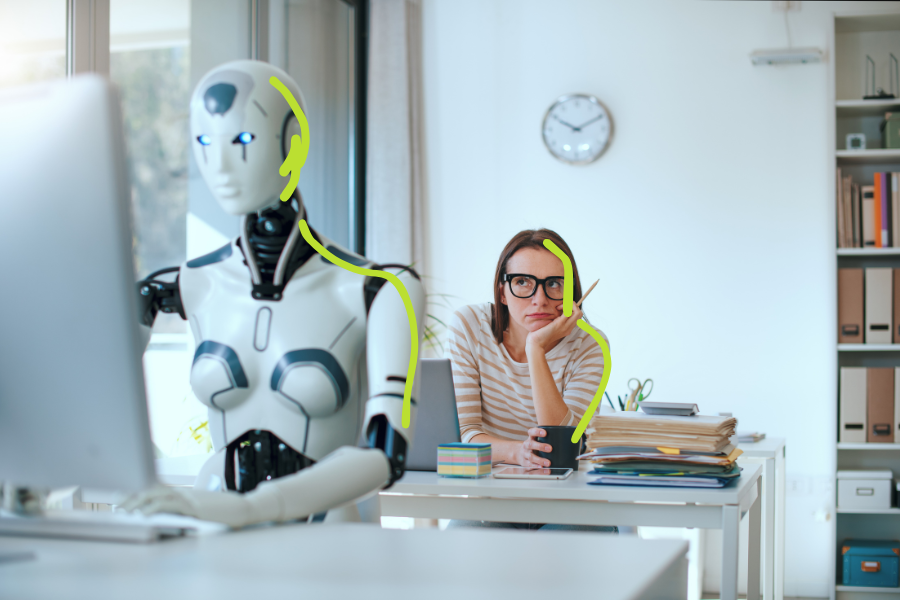
Anyone who rehearses a difficult conversation with AI enters the room better prepared, but the room itself has not changed. The article describes what artificial intelligence does to Able to and Safe to in teams and why leadership decides less through the tools than through the conversation about them.
More and more people use artificial intelligence to prepare for conversations they find difficult, and this is one of the more encouraging uses I know, because it helps people find words for something they would otherwise have kept to themselves.
In the PsychSafety newsletter I read an example: One person has built simulations of tense meetings and created profiles of the colleagues they struggle with, and has since entered such appointments much more calmly. Another has phrasings suggested because the right words often fail them in the middle of a conversation, and a third lets the AI take on the role of their manager to hear what they are missing.
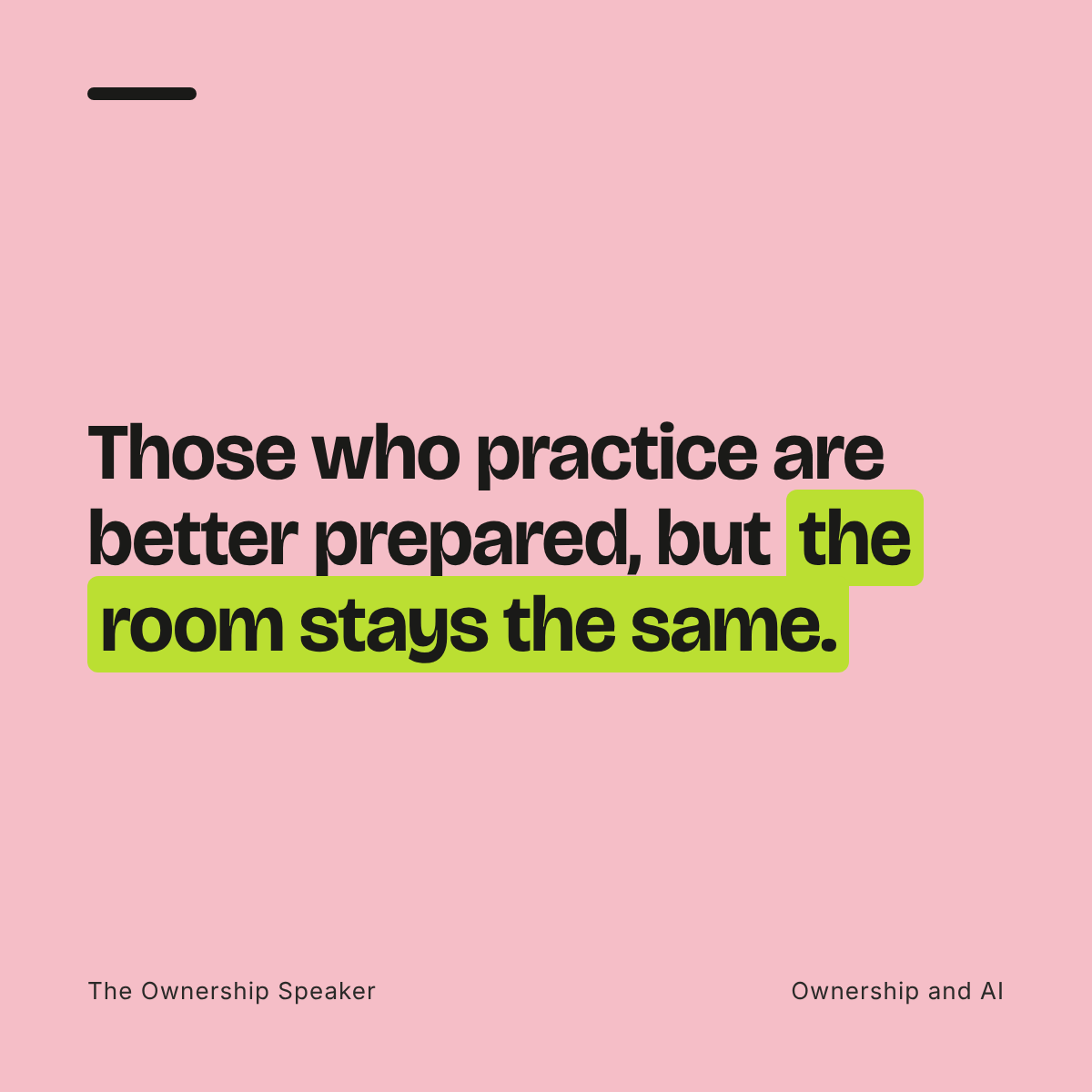
What changes here is the person and not the team. They enter the room better prepared, and in the ownership model that is a gain in Able to, because they now know what they want to say and how. Whether they actually say it depends on Safe to, however, and that has not changed, because the room has stayed the same, with the same reactions and the same consequences.
Those who practice are better prepared, but the room stays the same.
The same analysis contained a second pattern that has occupied me more, because it is quieter. Some of the respondents feel less secure in the team since AI has entered the picture, and this rarely comes from fear of the technology itself but from the fact that one’s own contribution has become harder to recognize. The sample was small and probably consisted mostly of people who are interested in the topic anyway, so I read the findings as a snapshot and not as a measurement.
The remark that a task could surely be done with AI stands for this pattern. Whoever hears it understands that their contribution has become replaceable, and whoever works in a team where professional boundaries blur suddenly notices how little they understand of the other person’s field. On top of that comes the pressure to learn yet another tool just to prove that one masters one’s work.
Among the everyday risks that a safe team makes affordable is admitting that you do not know something. When gaps in knowledge seem less forgivable because AI keeps raising the bar, this admission becomes more expensive, and those who can no longer afford it stop asking. This hits Safe to at its core, and it hits it quietly, because nobody forbids anything.
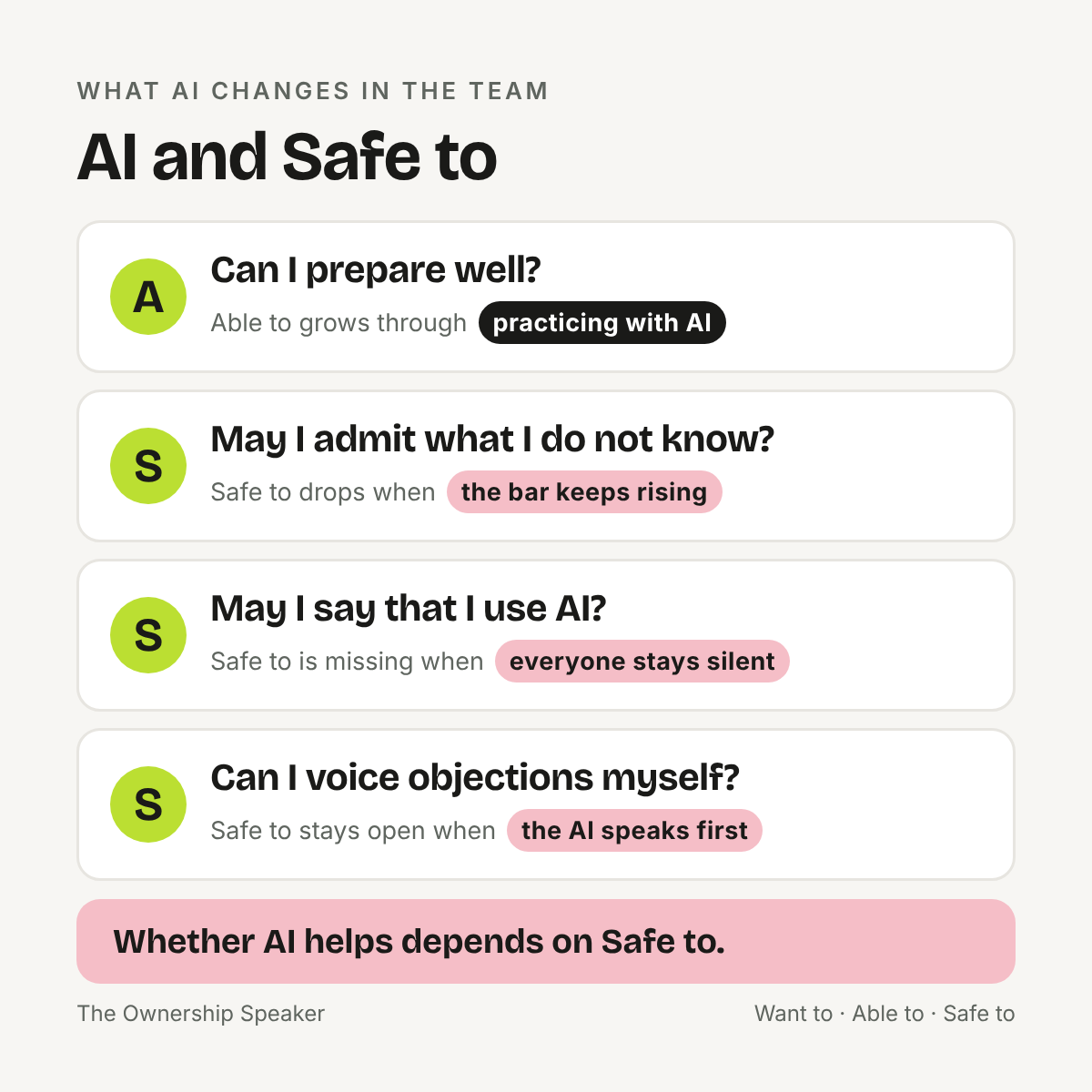
A third finding concerns hiding. Some employees use AI without saying so in the team because in their environment it counts as convenience or even cheating, and so a situation arises in which everybody uses the tool and nobody talks about it. Someone who describes themselves as a silent user because colleagues are afraid has answered the question of whether it is safe for themselves, and the answer is no. That it was a leader of all people who said speaking openly came more easily to them because they had less to lose shows how unevenly Safe to is distributed.
It gets interesting when the AI is no longer just a practice partner but a stand-in. When an objection comes from a tool and not from a colleague, it is easier to question because no relationship is at stake, and the same logic applies when someone has their own concerns formulated by the AI in order to distance themselves from them a little.
This is no thought experiment but something that can be observed in everyday work as soon as an idea shows up with the addition that it came from the AI. Suddenly everyone may criticize without offending anyone, and the group gets a sample of how dissent feels when it costs nothing.
This can be an intermediate step toward real dissent, but it can just as well be a more comfortable way of avoiding it. A group that needs a stand-in in order to disagree shows that direct disagreement is still risky, and that is not a statement about the technology but about the team. The same holds for practicing, because someone who plays through conversations with the AI instead of having them has prepared, but has not yet said anything.
My interpretation is that AI amplifies what a team already does with uncertainty. Where people can say what they are trying out, what they do not understand and what worries them, AI becomes one more topic that is learned together, and where they cannot, it becomes one more topic that is dealt with alone. This explains why the same technology brings relief in one team and withdrawal in the next, and it explains why the question of the right tool misses the point. What matters is the habit of talking about its use, because that turns AI itself into a safe topic of conversation.
The most important step is to begin yourself and to tell how you use AI, including where it got things wrong. Someone in a position where openness costs little can make it affordable for others, and that is work on Safe to that cannot be delegated.
The second step concerns the normality of not knowing. When the sentence that someone cannot do something yet is an ordinary sentence in the team, the rising bar loses part of its terror, and it helps to agree together how the team works with AI and to treat its results as a starting point for conversation. Shared rules make the room more predictable, and predictability is the first of the questions people ask themselves before speaking.
The third step is attention to those who become quieter or withdraw, because a team can imperceptibly turn into a collection of lone fighters. Whoever notices this should ask what has changed for the person instead of admonishing them to put in more effort.
Practicing with AI is welcome as long as the real conversation takes place afterwards, and this can be agreed explicitly. Leadership can ask, for example, how someone prepared for a conversation and then have the conversation instead of evaluating or even controlling the preparation.
One concern from the analysis I consider worth taking seriously, even though nobody reported it about themselves, namely that people who feel insecure in the team prefer to talk through their thoughts with an AI rather than with a human and become lonelier as a result. Then the tool replaces exactly the conversation a team needs in order to become safer, and the relief of the individual is paid for with a loss of connection.
The obvious reactions of organizations are a ban or a mandate, and both miss the problem because they start at the tool and not at the safety to talk about the tool. A ban pushes use into the hidden, where it already takes place anyway, and turns a quiet habit into a secret that has to be guarded. A mandate to use AI, on the other hand, raises the pressure to prove a new skill on top of the actual work, and hits exactly those who already wonder whether their contribution is still needed.
More effective is a frame that makes use, doubt and mistakes equally discussable. This includes that people may tell what AI does for them and where it fails without this turning into a verdict on their performance, and that it is normal to say of a task that one would rather discuss it with a human.
Anyone who wants to check this for their own team can start with a few questions.
Anyone who wants AI to make speaking easier has to make sure that silence does not stay more comfortable.
The Assessment compares your organization with others and delivers concrete recommendations, not just a diagnosis.
Start the Assessment