November 18, 2026 · by Stephanie Selmer · 7 min read
The sentence that nobody will be blamed in this meeting is meant to create safety and often achieves the opposite, because it forbids a feeling that cannot be forbidden. The article asks what leaders can say instead so that people name their part without fear of what comes next.
Many teams have resolved to work blamelessly after mistakes, and the idea behind it is right, because whoever looks for the culprit finds a name but rarely the cause. In the PsychSafety newsletter I read a piece that looks at the matter from the other side and makes a simple observation: Whoever declares a debrief blameless does not stop feeling blame, people just stop bringing the feeling into the room.
The feeling stays, it goes underground, and there it keeps working, in conversations in the hallway, in cautious wording and in reports that leave out everything important. A manager who announces a blameless climate therefore often experiences a meeting that runs friendly and yields nothing, because every person has long since calculated for themselves who will have to answer for it in the end.
A second misunderstanding comes on top that weighs at least as heavily. Many hear in the word blameless the sentence that nothing will happen, and after a serious incident nobody who knows the consequences believes that, least of all those who bore them.
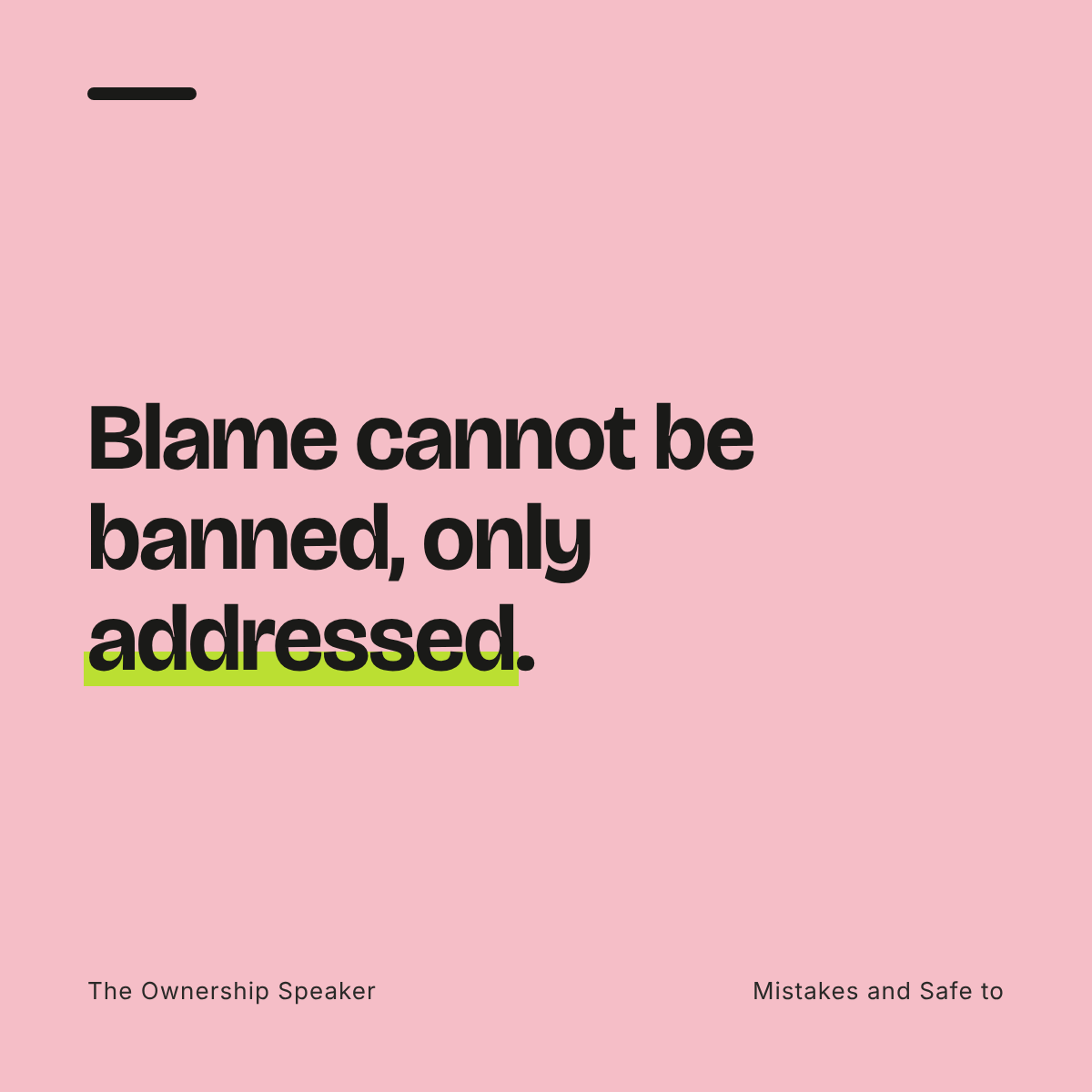
A feeling cannot be forbidden, but it can be addressed.
What works better?
The piece comes from an author who works on the debriefing of incidents and coined the term blame aware ten years ago. It describes an attitude that recognizes blaming, of others as well as of oneself, as a normal and even necessary human reflex, gives it a voice and meets it with empathy instead of pretending it does not exist.
The idea behind it is that the reflex becomes less harmful once it is spoken. That creates trust, because everybody knows they could blame and deliberately do not, and it brings to light the reasons why people acted the way they acted. In the newsletter I read an example that I find remarkable: A team opened its debriefs with a relaxed round in which everybody said, half in jest, whom or what they currently blame, and mostly it was those who blamed themselves who started. That loosened the mood and led to more detailed accounts, and where somebody stayed silent, that too was useful information.
What is the difference between blame and consequence?
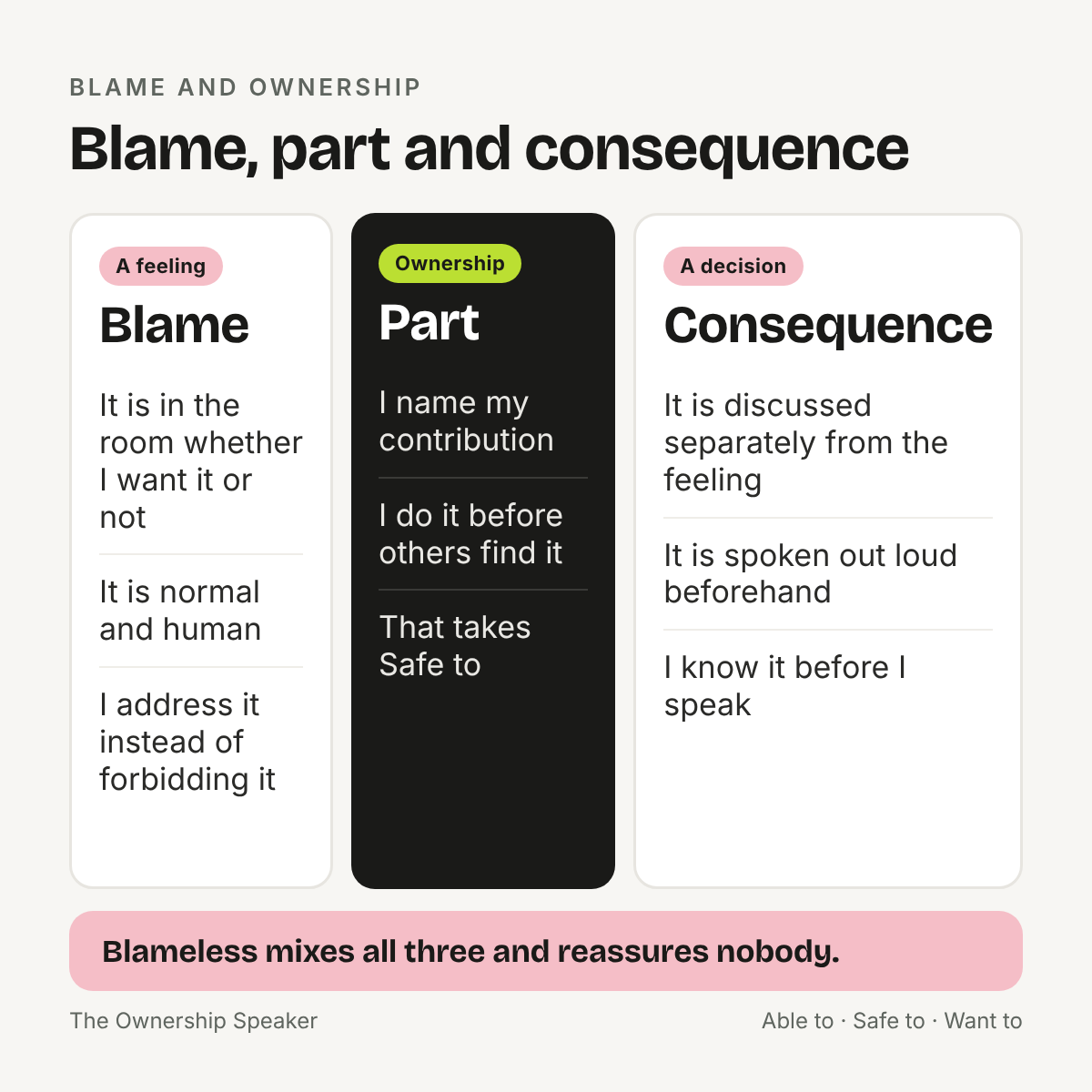
I find the distinction the piece makes between blame and sanction helpful, because the two are constantly confused in everyday work. Blame is a feeling and a social reaction that protects norms, whereas a sanction is a decision by leadership that can be made and justified. Whoever mixes the two either promises too much, namely that nothing ever happens, or punishes out of reflex. Whoever separates them can say that feelings of blame are welcome, that they will be discussed and that consequences will be decided separately and comprehensibly, and exactly this information is what people need before they dare to admit a mistake.
What does this mean through the ownership lens?
Ownership begins with somebody naming their part before others find it, and that includes Safe to, which does not arise from the announcement blameless. It arises when somebody knows beforehand what follows from naming it, spoken out loud and not assumed. Want to is usually present in such meetings, and Able to too, because those involved know exactly what went wrong. What is missing is the certainty that the truth will not be used against them, and no label can give them that, only a leader who commits.
Committing means saying beforehand what happens in which case. An oversight in everyday work has no consequences beyond learning, a deliberate breach of rules on the other hand does, and whoever knows this beforehand can judge which category their mistake falls into. This clarity is less comfortable than a feel-good promise because it names limits, but it is more honest, and honesty is the foundation on which somebody risks something.
On top of that comes what leaders model themselves. Whoever is the first to name their own part in a failure gives everybody else permission to do the same, and whoever says the sentence that there is no blame in this meeting and then still exposes somebody destroys with one single reaction what took months to build.
What does a meeting look like that takes blame seriously?
A meeting that takes blame seriously does not begin with the prohibition but with the question of how those involved are doing with it. The leader first says what is on her own mind and then invites people to say whom or what they currently hold responsible, themselves included. After that it is separated what there is to learn and what, if anything, there is to decide, and consequences are not discussed in the same meeting and not in the heat of the moment. That sounds more laborious than a sign saying blameless, but it saves the hallway conversations that otherwise replace the actual debrief.
Where does this approach reach its limit?
I do not want to conceal that openness about blame can also go wrong. Where leadership is weak or sanctions turn out arbitrary, a spoken accusation becomes a weapon and the relaxed round a ritual that nobody takes seriously anymore. The author himself concedes that there can be reticence in such meetings, but for him it too is information, namely that something in the room does not hold.
I find his closing remark noteworthy, that the memorable name overshadowed the actual purpose, namely debriefs from which actions follow. This applies to every label, to blameless and to ownership as well: Whoever only changes the word changes nothing, and whoever changes the practice can work with any word.
What applies after a serious incident?
It gets hardest when a mistake has caused real damage, because then the word blameless quickly sounds cynical to those affected. Whoever has lost a customer, a team or their own health does not want to hear that nobody is to blame here but that somebody takes the damage seriously and that there may be consequences. The separation of feeling and decision helps particularly at this point, because it allows both, the acknowledgment that somebody is angry or disappointed and the sober question of what the behavior of those involved was and whether it was appropriate in this case. Open consequences are no obstacle to ownership as long as they were known beforehand, because whoever knew the rules can stand by their part even in the worst case.
What do you say before the next mistake happens?
Anyone who wants to check this for their own area can start with a few questions.
Safety does not arise from the prohibition of a feeling but from a promise about consequences that somebody can keep.
Sources
Reflections after reading the newsletter “Psychological Safety” (psychsafety.com, issue #282, October 23, 2026), including a piece discussed there on ten years of “blame aware”. psychsafety.com
Psychological safety
Ownership
Safe to
Error culture
Where does your organization stand on ownership?
The Assessment compares your organization with others and delivers concrete recommendations, not just a diagnosis.