October 12, 2026 · by Stephanie Selmer · 8 min read
An accountant is admitted to a leadership program through a mix-up, stays silent for fifteen months and, shortly before completion, himself names what he noticed early on. The case shows how Want to can arise when someone is given room, and why a Safe to that rests on an error becomes resilient only through a conscious decision.
In a large corporation there are two employees with exactly the same first and last name. One works in accounts payable and on good days waits three hours for invoices, the other sits in sales at a different location, is ambitious and applies for a place in the talent program for the third time. The acceptance from the HR department goes to the accountant, who first takes it for spam and then for a friendly gesture from his supervisor.
He accepts and shortly afterwards sits in a lakeside hotel where everyone else introduces themselves with their future areas of responsibility, while he introduces himself as an employee of accounting. Right there he notices that something is off, but he stays, because there is wine in the evening and nobody misses him at the office. The story comes from a person who told it anonymously and whose truthfulness cannot be verified, yet it works as a case, because it shows a pattern that occurs in organizations more often than one thinks.
Want to was never gone, it just had no room.
How underchallenge turns into Want to
Over the following fifteen months he attends five modules, completes a coaching, takes a personality test and a 360-degree feedback, for which he asks two colleagues from accounting to rate his leadership impact, and they give him full marks, laughing. He voluntarily reads books about leadership and, by his own estimate, gets more involved in it than in his actual job in the five years before combined.
What is remarkable here is less the mix-up than what it uncovers. A person who is only waiting in their role has presumably lost neither Able to nor Want to, but never got the room to show both. As soon as this room is there, with appointments that matter and people who ask questions, Want to grows faster than any target agreement could have produced. In the terms of the ownership model, Safe to was missing here before, and with it came everything else.
This is an uncomfortable finding for organizations that complain about a lack of personal responsibility, because it shifts the question from the attitude of individuals to the conditions they find.
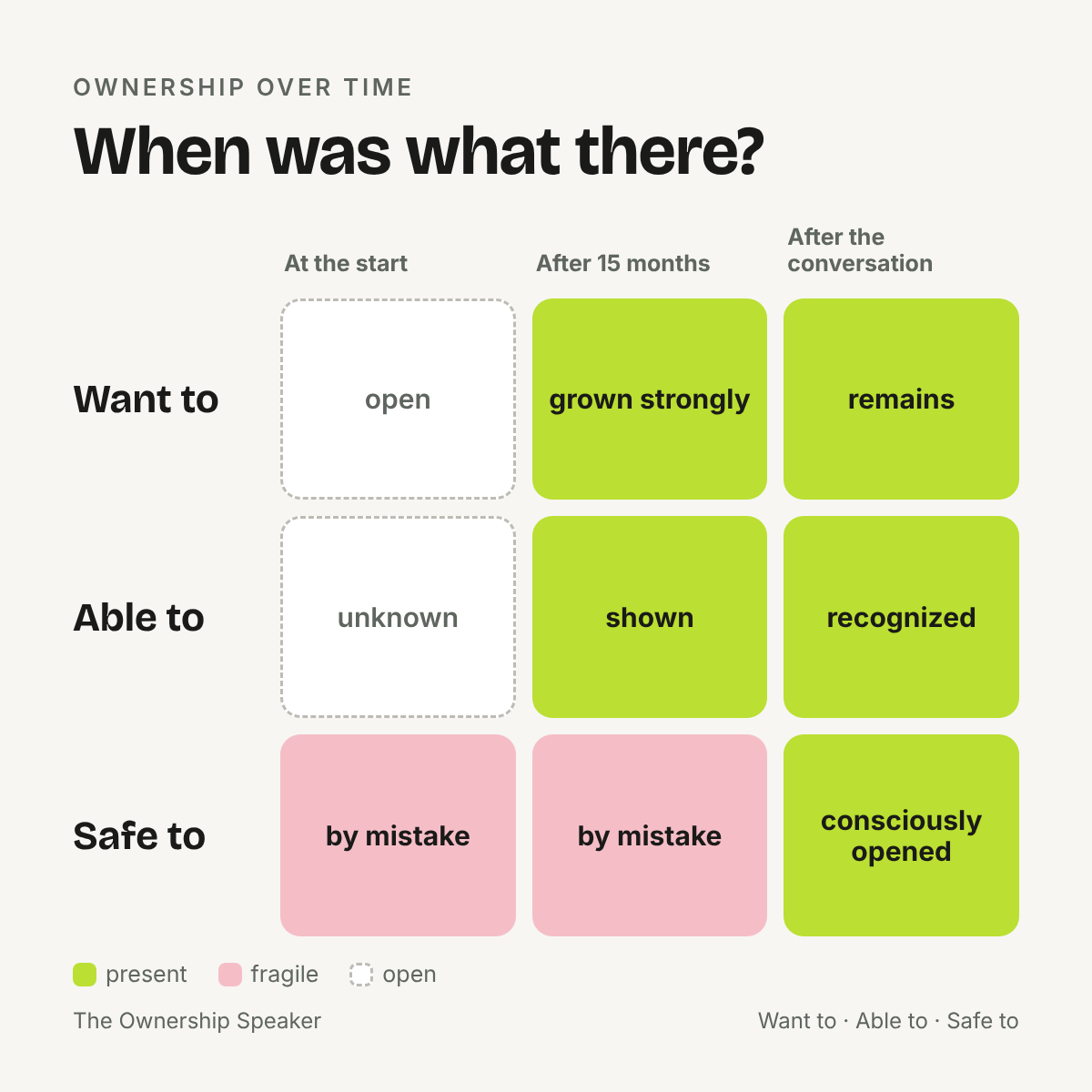
When was what there?
At the start, the room for Safe to was formally opened, but by mistake, Want to was open and Able to unknown. After fifteen months, Want to had grown strongly and Able to had been shown in the program, but Safe to still rested on an error.
Only in the conversation with the program management and the CFO was the room for Safe to opened anew, this time consciously and in knowledge of the mistake. A chance decision thus became a decision.
Why nobody asked for so long
In his supervisor's calendar it merely said that the employee was in a training approved by HR, and nobody asked who had nominated him for it. According to the account, the supervisor is friendly but is mainly concerned that the monthly closings are correct, and the mentor in the program, a member of the top finance leadership, interpreted the participant's low ambition as a strategy and found it refreshing. So everyone involved had a good reason not to question anything, and each reason was reasonable in itself.
This is how an error often arises in organizations that is caused by nobody but carried by everyone, because asking costs time and because the assumption that someone will surely have checked is comfortable. For the employee there was the additional point that he could understand the invitation as a gesture, and whoever accepts a chance without checking whether it is meant for them quietly takes on a part of the responsibility for the answer.
The error became more expensive with every month, because with every module more people, time and money hung on it, and a confession therefore becomes harder the longer the silence lasts.
Your own part
When the HR department notices the error and asks for a short phone call, the employee faces a choice in which the obvious advice is to keep quiet, act ignorant and take the position. He decides differently and starts the conversation himself, thanks them for the chance and says that he suspected a mix-up at the first module and should have reported it.
The HR employee is silent at first and then confesses that she had seen the error a week earlier and had not dared to call him, because the selection had been her mistake.
What the organization made of it
The program management at first rates the incident as serious and considers exclusion the obvious consequence. Then the CFO speaks up and says he does not care how the employee got in, because for fifteen months he has seen what came of it, and a program in which someone from accounting can run along for a year and a half without being noticed is perhaps not only the problem of a single participant.
The result is remarkably balanced. The employee completes the program, he does not get the team lead position in sales because it would not have made sense professionally, his ambitious namesake gets a fixed place in the next cohort and preferred consideration for the next suitable position, and in accounting a team lead position becomes free in the spring, for which he is to apply quite regularly, with clear tailwind from the top finance leadership.
This shows how a confession can work in an organization when someone with decision-making power treats it not as an attack but as information. Responsibility was visibly distributed, to the HR department, to the program management, to the procedure and to the employee himself, and only then could a solution arise that exposed nobody.
The outcome was not inevitable. The program management could have decided on exclusion, the CFO could have stayed silent, and the employee bore the risk that his confession would be interpreted as deception, which can have serious consequences in many companies. That he did it anyway, without knowing how it would turn out, is the part of the case that cannot be generalized, because it depended on the attitude of one person and on the behavior of one board member.
At the same time a remainder is left that should not be explained away. The supervisor was the last to find out, reacted with a friendly sentence about luck and, as the employee himself suspects, would have liked to know earlier, and the relationship between the two has been noticeably tense since.
What follows from this for leadership
First, the case shows that organizations deal worst with a mid-sized error. Small errors are corrected without anyone thinking about it, very large ones are carried by so many that nobody is solely to blame, but an error that is too big for quiet correction and too small for shared responsibility easily ends in silence, because everyone involved has something to lose.
Second, it shows that the person who names their own part first gives the others the possibility to do the same. The HR employee could only voice her fear because the conversation did not begin with an accusation, and the CFO could only ask the question about the system because the employee had not built up a defense.
Third, it contradicts a widespread assumption about who should take on leadership. The namesake, who likes to stress leadership and applied three times, came away empty-handed, while the reserved colleague, who never aimed for it, was given the responsibility, which does not mean that ambition is a disadvantage, but that volume is not a reliable indicator of ownership.
Fourth, it shows what leadership makes visible when it looks closely. The CFO had accompanied the participant for months and could therefore judge what he had achieved, instead of only asking how he got in, and an assessment based on observation is the counterpart to a selection that had gotten stuck in the procedure.
Questions about your own stance
The case works as a mirror for your own handling of chances, errors and confessions, and those who want to use it can begin with a few questions.
The employee writes that he could not have made it up better himself, and yet it was not providence but a sequence of decisions that nobody took off him. The room for it came through an error, but that it became a viable role is something he earned himself in the moment of the confession.
Sources
Anonymous account on r/Beichtstuhl (Reddit), flair “Täuschung” (deception), post “HR hat mich mit einem Namensvetter verwechselt und ich mache seit 15 Monaten ein Führungskräfteprogramm, für das ich nie ausgewählt wurde” (HR mixed me up with someone of the same name and I have been doing a leadership program for 15 months that I was never selected for), with two updates by the author, reproduced in essence, names changed by the author, truthfulness not verifiable. reddit.com/r/Beichtstuhl
Leadership
Ownership
Error culture
Development
Where does your organization stand on ownership?
The Assessment compares your organization with others and delivers concrete recommendations, not just a diagnosis.