September 9, 2026 · by Stephanie Selmer · 8 min read
Psychological safety is often treated in organizations like a switch that is either on or off, yet Timothy Clark describes four stages that build on each other and differ clearly from one another. Those who know these stages understand better why people in a friendly team are allowed to belong and to learn, but still do not take responsibility, and where ownership actually begins.
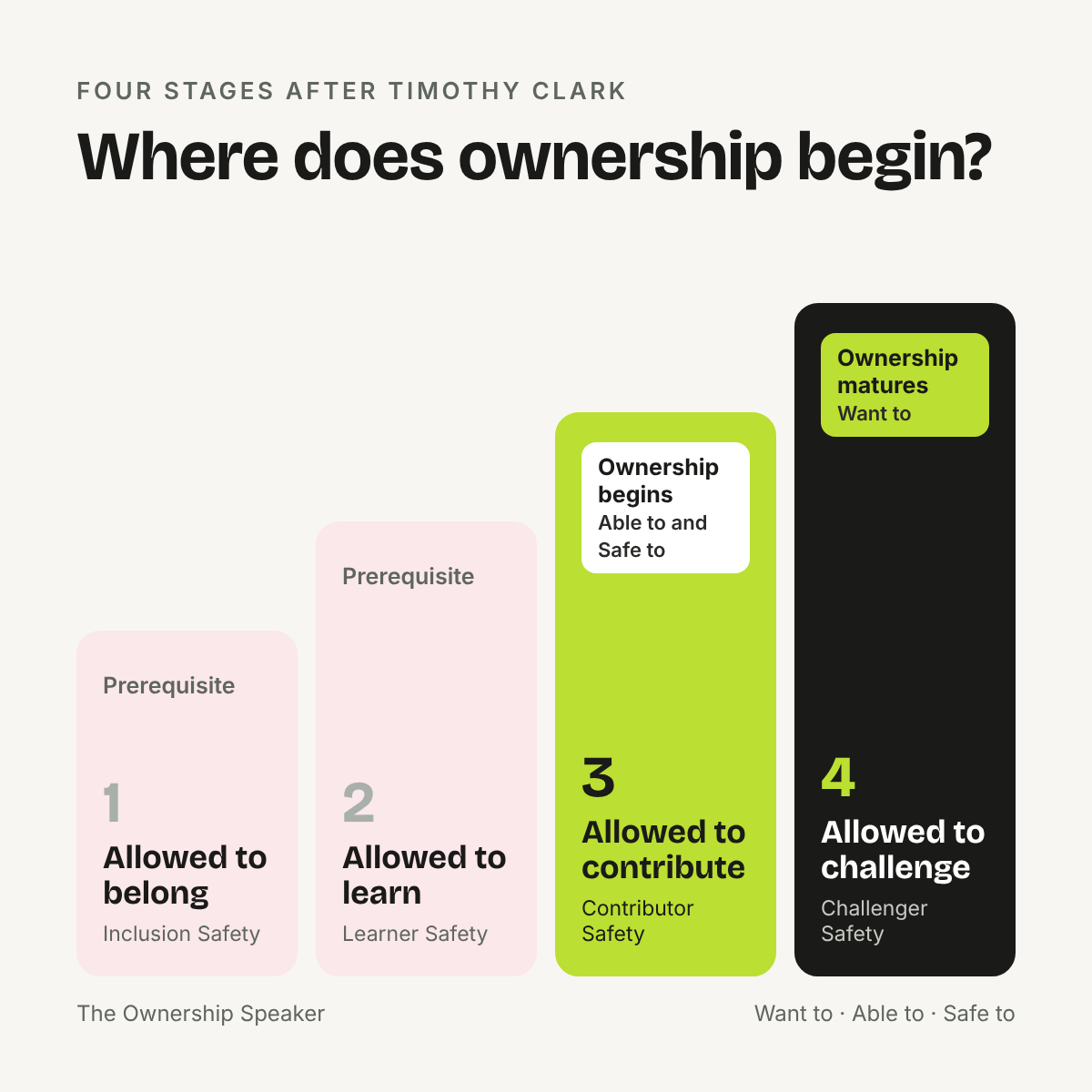
The organizational consultant Timothy R. Clark describes psychological safety not as a uniform state, but as a sequence of four stages, each of which addresses a basic human need and builds on the previous stage. The stages are called Inclusion Safety, Learner Safety, Contributor Safety and Challenger Safety, and you can imagine them as a staircase on which each step lies a little higher than the one before.
The practical value of this model lies in the fact that it answers a question the concept of psychological safety alone leaves open, namely which kind of safety is currently missing in a team. A team in which nobody dares to challenge the status quo has a different problem than a team in which new colleagues still do not feel they belong even after months, and the measures that help the one remain ineffective for the other.
Being allowed to belong
Being allowed to learn
Being allowed to contribute
Being allowed to challenge
Stage one: Being allowed to belong
Inclusion Safety forms the foundation and describes the feeling of being accepted as a person and belonging to the group, regardless of background, status, age or demeanor. As long as this stage has not been reached, people spend a considerable part of their energy on fitting in, hiding their opinion and avoiding risks, and this energy is then missing from the actual work.
For ownership, this stage is indispensable for a simple reason, because nobody takes lasting responsibility for a house in which they feel like a guest. Those who belong to the organization can make its goals their own, those who are merely tolerated will at best carry out assignments.
Stage two: Being allowed to learn
Learner Safety concerns the possibility of asking questions, accepting feedback, trying out new things and making mistakes in the process, without being shamed or punished for it. Here Clark's model meets Edmondson's work, because a team's ability to learn from mistakes depends directly on whether mistakes are reported, and they are only reported if reporting is not dangerous.
Many organizations have invested considerably in these first two stages in recent years, with programs on diversity and belonging, with learning formats and with a culture of open feedback, and this is undoubtedly worthwhile. It does, however, lead to a trap that is described in more detail below, namely the assumption that with the learning culture the work on responsibility has already been done.
Stage three: Being allowed to contribute
Contributor Safety describes the need to use one's own abilities to make something happen, with a leeway that goes beyond carrying out instructions. Clark understands this stage as a kind of agreement in which people receive autonomy and in return take responsibility for the quality of their contribution, and it is exactly at this point that ownership in the true sense begins.
In the Ownership Triangle, Able to and Safe to coincide here. Able to is given by qualification and the available means, Safe to by the room for decisions, and both must be present at the same time for someone not just to complete a task but to take responsibility for it. That many organizations fail at this point rarely has to do with a lack of will, it is rather due to structures that assign people responsibility but withhold the necessary authority from them, for instance through multi-level approval loops, through decisions that are delegated upward along the line, or through leaders who regard every deviation from their own approach as a quality problem.
Stage four: Being allowed to challenge
Challenger Safety is the highest stage and describes the freedom to question the status quo, to voice disagreement and to propose changes, even when this is uncomfortable or directed against people with more power. Here responsibility goes beyond one's own task, because those who challenge the status quo take responsibility for the whole, that is, for the question of whether the organization is doing the right thing and whether it is doing it right.
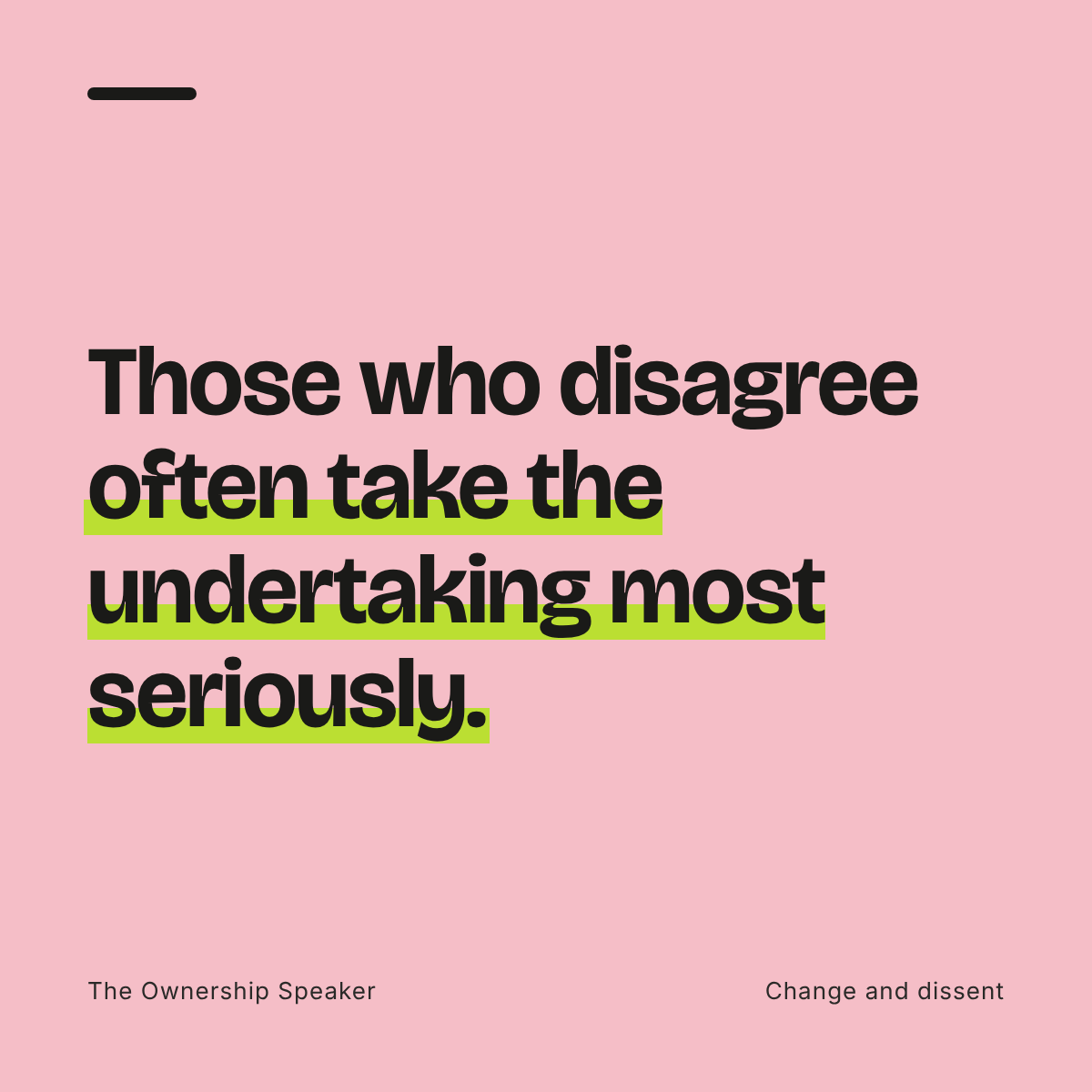
In the language of the Ownership Triangle, this corresponds to Want to in its most mature form, namely the concern that something succeeds because it matters to someone, and not because it was ordered. For change initiatives this has a practical consequence that can be uncomfortable. People who accompany an undertaking critically are not brakemen who need to be convinced, but are often the ones who take the undertaking most seriously.
Where ownership begins and where it fails
From the four stages, an assignment can be derived that does not come from Clark but is a translation into the Ownership Triangle. Stages one and two create the prerequisites, because they secure belonging and the ability to learn, stage three is the point at which ownership begins, because Able to and Safe to come together there, and stage four is the point at which it matures, because there Want to turns toward the whole.
The typical trap is that organizations work seriously on the first two stages and then expect ownership to arise by itself. People feel they belong and are allowed to learn, but the decision rights still lie with others, the goals are set from above and contributions are measured above all by whether they meet the requirements. The result is a team that feels good, learns a lot and still does not act, because acting is not provided for.
Safety can also be lost again
One point is easily overlooked in the discussion of stage models, namely that the stages are not an award that a team earns once and then keeps. A new leader, a restructuring or a single reaction in a critical situation can cause a team that has so far worked at the fourth stage to fall back to the second within a few weeks, because the experience that disagreement had no consequences no longer holds. Safety is therefore less a state than an ongoing attribution that is confirmed or devalued in every interaction, and it demands attention especially in phases in which a lot is changing. For change initiatives this is an uncomfortable insight, because precisely when ownership is needed most urgently, the conditions for it are most at risk.
What leaders can do at each stage
At the first stage, it is about making belonging tangible, for instance by actively involving new people and treating differences as a resource rather than a deviation. At the second stage, what counts above all is one's own reaction to mistakes and questions, because it shows whether learning is wanted or only proclaimed. At the third stage, the task is to deliberately hand over decision rights, to formulate expectations clearly and then to endure that things are solved differently than usual. At the fourth stage, finally, what matters is to explicitly invite disagreement and to acknowledge it visibly, even when it concerns one's own position, because otherwise the invitation remains lip service.
Questions for determining your own stage
For practice, it is worth asking one question per stage and answering it honestly, where the first stage that is answered with no usually shows where the work needs to start.
What this means for communicating change
For change initiatives it follows that the stages cannot be skipped and that participation formats are only worth as much as the authority that accompanies them. A dialogue event at which everyone may ask questions serves stage two, and it makes sense there, but it creates cynicism if the participants subsequently find that their input had no effect on the decision. Those who announce participation should therefore clarify in advance which decisions are actually open and communicate this honestly, because people accept a clear limit to their room for maneuver more readily than the claim of a room that does not exist.
The four stages are therefore less suited as a maturity model to be ticked off than as a basis for conversation in leadership teams that ask themselves why little initiative arises despite an open culture. Usually the answer lies not in the attitude of the employees, but in the question of whether the third stage has actually been built, that is, whether people are allowed to make a difference with their abilities and receive the backing that this responsibility needs.
Sources
Clark, Timothy R. (2020): The 4 Stages of Psychological Safety. Defining the Path to Inclusion and Innovation. Oakland: Berrett-Koehler Publishers.
Edmondson, Amy C. (2018): The Fearless Organization. Creating Psychological Safety in the Workplace for Learning, Innovation, and Growth. Hoboken: Wiley.