October 19, 2026 · by Stephanie Selmer · 8 min read
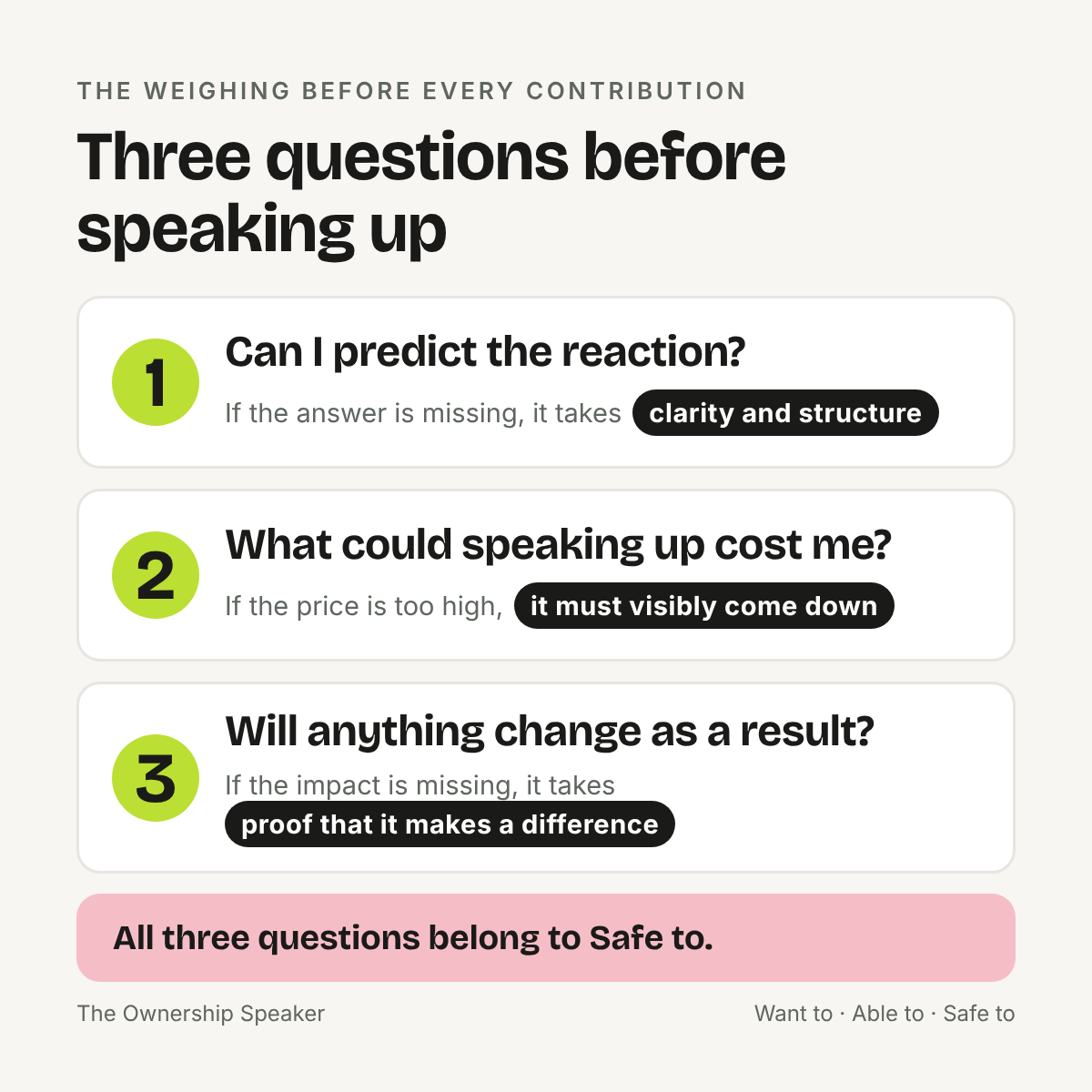
When a team stays silent, people quickly ask about willingness, yet from the perspective of ownership what is usually missing is Safe to, because before every contribution people unconsciously weigh whether they can predict the reaction, what it will cost them and whether it will change anything. Depending on which answer is missing, a team needs orientation or visible proof that contributions have an effect.
When a team stays silent, the first diagnosis in many management offices is that the will is missing, and the wish for more ownership turns into an appeal to please contribute more. From the perspective of ownership this is the least likely explanation, because ownership consists of Want to, Able to and Safe to, and people who see a problem clearly and still say nothing usually do want to, only something else stands in the way.
Create a photorealistic image in 3:2 format: A single empty chair at a long meeting table, in front of it an open notepad with a small pocket calculator, soft daylight from a window, main subject in the center, natural colors, no stock photo look, no text in the image.
Anyone facing a silent team therefore does not see a lack of attitude but the result of three variables, and the task is to find the missing one before choosing measures. Most often it is Safe to, sometimes Able to and rarely Want to, and each of the three calls for a different answer.
Where people stay silent, the will is rarely missing, more often Safe to.
Which question is the team answering with silence right now?
Safe to is not a trait of character but a judgment that people make anew before every contribution, and it is made up of three questions that are never asked aloud. Can I foresee how the group will react, what will the contribution cost me in standing, in relationships or in peace, and will it change anything at all?
What matters is that the answers come from experience and not from announcements. A sentence like “Everyone can say anything here” answers none of the three questions if the last person who spoke up had a bad moment as a result or learned that nothing happened afterwards. The three answers reinforce or dampen one another, because anyone who knows the impact will also bear a high price, and anyone who knows neither the reaction nor the impact stays silent even at a low one.
What to do when the reaction is unpredictable?
Some teams stay silent because they cannot judge the reaction. The manager shows interest one day and irritation the next, objections are praised on one day and passed over on the next, and nobody knows which side they will catch. Anyone who experiences such an environment may have wanted to and might also have been able to, but Safe to lacks a foundation because the risk cannot be calculated, and silence is then the sensible decision.
What these people are missing is orientation, that is, clarity about when and how objections are raised, who takes them up and what happens to them afterwards. This is also a question of Able to, because it takes not only expertise but knowing by which route something can be said in this organization. A fixed process does not replace trust, but it gives Safe to a foundation on which it can grow.
Why do contributions stay without consequences, and what do people learn from that?
Other teams stay silent for the opposite reason. For them the reaction is quite predictable, namely friendly and without consequences, and that is exactly the problem. They have experienced objections being noted, ideas being praised and warnings being gratefully received without anything moving afterwards, and they draw the only logical conclusion, that the effort does not pay off. At this point not only Safe to but also Want to loses its reason, because nobody holds on for long to something that achieves nothing.
Rules do not help these people, because they have known the rules for a long time. What they lack is proof that a contribution achieves something, and that can only be provided through action. Whoever receives a hint should make visible what became of it, even if the answer is that it was examined and deliberately not implemented, because a reasoned no still shows that someone listened.
The two cases look the same from the outside, but they call for opposite answers. Anyone who offers more structure to a team that doubts the impact reinforces the impression of busywork, and anyone who provides evidence of impact to a team that cannot judge the reaction misses its actual question.
And what does it cost me?
The middle question is underestimated most often, because costs are rarely named openly. They sit in glances, in pauses, in the way an objection is summarized and in what happened to the person who last said something uncomfortable. People remember these scenes very precisely and read them as a price list for their own contribution.
Every reaction to an uncomfortable contribution is therefore a price quote for everyone who watched. Whoever objects and receives thanks lowers the price for the whole team, and whoever meets sharpness raises it for everyone, including those who were not in the room and only heard about it.
This makes Safe to the most sensitive of the three prerequisites of ownership, because it is not decided but experienced, and a single scene in which someone was exposed for an objection has to be overwritten by a whole series of opposite scenes before the calculation shifts in the minds of those involved.
What does this mean for your ownership work?
Appeals to personal responsibility address Want to and leave the calculation untouched, and anyone who does not change the calculation does not change the behavior either. A person can want to and be able to and still say nothing if they cannot judge the reaction, consider the price too high or expect no impact, and from the outside it then looks as if the will is missing, although only the calculation does not add up.
Ownership therefore emerges where people experience that their contribution is heard, that it costs them nothing and that it moves something, and this cannot be ordered but only produced through repeated experience. This also applies to managers, who calculate by the same pattern. Whoever has experienced that an admission had consequences hardly raises uncertainties anymore and thereby passes downward what they learned from above, so that the calculation propagates through an organization until everyone takes it for reality.
How can you tell which answer is missing in your team?
Before you plan measures, it is worth finding out which of the three questions is open in your team, and a few honest conversations are often enough.
The answers usually show quickly whether your team lacks predictability, protection or impact, and thus where you should start.
What can be changed?
When the reaction is unpredictable, fixed forms help, for example a round in which objections are explicitly welcome and collected before the meeting so that nobody has to improvise. When contributions remain without consequences, visible follow-up helps, in which hints are noted with a date and later published together with their fate. When the price is too high, the behavior of the manager helps above all, because she can lower it fastest by visibly appreciating the first uncomfortable contribution.
None of these measures is new, but they only work if they fit the open question. Whoever supplies the missing answer can experience people speaking again, not because they have suddenly become more motivated but because the calculation has changed.
It also helps to talk openly about the calculation. A team that is allowed to name what it weighs takes the secrecy out of silence, and often it turns out that the reasons are not at all where the manager suspected them.
So the next time you sit in front of a silent team, do not ask why people do not want to, but what they are calculating at the moment.
Sources
Reflections after reading the newsletter “Psychological Safety” (issue 281, October 2026). psychsafety.com
Psychological safety
Ownership
Safe to
Team culture
Where does your organization stand on ownership?
The Assessment compares your organization with others and delivers concrete recommendations, not just a diagnosis.